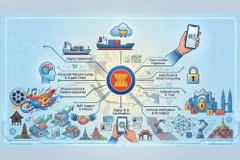
Southeast Asia gains ground amid shifting supply chain

With geopolitical tensions pushing companies to diversify, manufacturers are increasingly moving plants out of China, said Mads Lauritzen, chief strategy officer for Southeast Asia and supply chain lead for Asia-Pacific at Accenture.

Hanoi (VNA) – The “China plus one” playbook is giving way to “South-east Asia plus one” as manufacturers shift production within the region rather than out of it amid supply chain disruption and tariffs, reported The Business Times.

The recent Southeast Asia Growth Forum, jointly organised by The Business Times and the Singapore Economic Development Board (EDB), closed with a panel discussion on building competitive and resilient supply chains in Southeast Asia.

With geopolitical tensions pushing companies to diversify, manufacturers are increasingly moving plants out of China, said Mads Lauritzen, chief strategy officer for Southeast Asia and supply chain lead for Asia-Pacific at Accenture.

Lauritzen puts global revenue lost to supply chain disruption at 1.9 trillion USD a year, roughly half the size of the Southeast Asian economy, and rising.

According to the speakers, combining Singapore’s strengths with those of neighbouring manufacturing hubs will build a more efficient regional supply network, thereby bolstering the competitiveness and resilience of Southeast Asian companies./.


VNA

See more

The scene of the fire at the Fonusa Agung Mulia factory in Indonesia’s Banten province on November 22 (Photo: Xinhua/VNA)

Fire leaves 40 missing in Indonesia

Indonesian rescue forces are searching for 40 people missing after a fire broke out at a confectionery and sugar products factory in western Jakarta.

Malaysia prioritises domestic rare earth processing industry

Malaysia prioritises domestic rare earth processing industry

The Malaysian government has established a mechanism to consider the limited and conditional export of REE for research, development and processing purposes, aiming to develop the entire mineral industry value chain, covering upstream mining, midstream processing and separation, and downstream production of high-value-added products.

ASEAN Secretary-General Kao Kim Hourn announces the outcomes of the 49th ASEAN Summit and related meetings at the ASEAN headquarters in Jakarta, Indonesia, on November 18, 2026. (Photo: VNA)

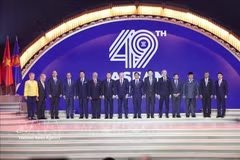
49th ASEAN Summit highlights action-oriented regional cooperation

As 2026 marks the first year of implementing the ASEAN Community Vision 2045, leaders underlined the bloc's solidarity and centrality as well as closer coordination among the three community pillars in response to global economic uncertainties and security challenges, with priorities including digital transformation, AI application, energy security and supply chain resilience.

ASEAN Secretary-General Kao Kim Hourn (Photo: VNA)

Growing together: 11 nations, one ASEAN home

The new emblem signals an ASEAN that is growing more inclusive while holding to its founding principles of building a peaceful, stable, dynamic region based on equality and cooperation. Its colours come from member states’ national emblems, reflecting diversity inside a single community.

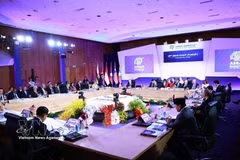
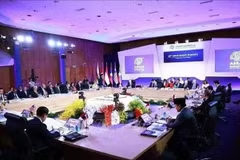
An overview of the dialogue between ASEAN leaders and the ASEAN Business Advisory Council (ASEAN-BAC) in Manila on November 15 (Photo: VNA)

Vietnam puts forward priorities to advance ASEAN cooperation

Appreciating ASEAN-BAC’s report and recommendations, Deputy Minister of Foreign Affairs Dang Hoang Giang, head of Vietnam’s ASEAN Senior Officials’ Meeting (SOM) delegation, called for simplifying procedures, reducing costs, accelerating digitalisation, upgrading the ASEAN Single Window (ASW) and effectively implementing the ASEAN Digital Economy Framework Agreement (DEFA) to make the regional market more accessible.

ASEAN signs Digital Economy Framework Agreement

ASEAN signs Digital Economy Framework Agreement

The Digital Economy Framework Agreement (DEFA), the bloc’s first standalone and legally binding digital economy agreement, establishes common rules covering digital trade, cross-border data flows, electronic payments, cyber security and artificial intelligence (AI).