Vietnam, Germany suggested to boost practical high-tech agricultural cooperation

The experts stressed that success should not be measured by how much German technology is brought into Vietnam, but by whether the two sides can develop solutions that work in Vietnam and deliver lasting benefits for farmers, the economy and the environment.

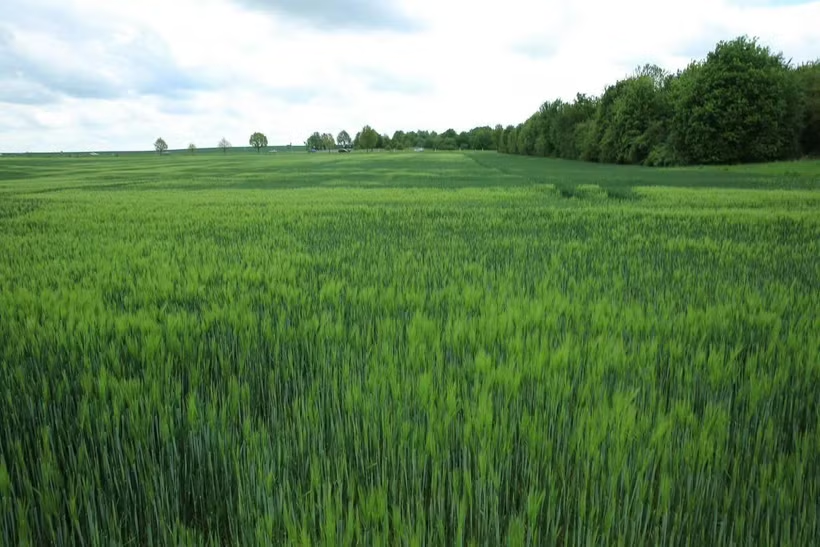
Green wheat fields in Merseburg, Saxony-Anhalt, Germany. (Photo: VNA)

Berlin (VNA) – Vietnam’s drive towards modern, green and sustainable agriculture, increasingly driven by science – technology, is opening up significant opportunities for cooperation with Germany, but German experts say the focus should be on developing solutions suited to Vietnam rather than simply importing ready-made technologies.

Heinrich Gerd-Witte, Advisory Board Member and Chairman of the Agriculture and Food Committee of the German Federal Association for Economic Development and Foreign Trade (BWA), and Hans-Joachim Radtke, BWA’s trade representative for Vietnam and Chairman of the German-Vietnamese Innovation and Economic Forum, highlighted the strong potential for bilateral cooperation in this sector.

Radtke said Vietnam is heading in the right direction with economic reforms and has considerable scope to apply AI and other advanced technologies in agriculture. The key, he stressed, is ensuring that technology delivers clear economic value.

Vietnam also needs a pragmatic path towards net-zero emissions, learning from mistakes made by Germany and Europe rather than repeating them, he said.

The two experts noted that Vietnam possesses a solid agricultural foundation and is a dynamically developing economy. However, like many other countries, climate change, water pressures, urbanisation and rising demand for safe and sustainable food are creating an urgent need for new agricultural solutions.

Gerd-Witte said the goal of bilateral cooperation is not only to develop agriculture and improve the livelihoods of local people but also to help Vietnam's agricultural products gain better access to global markets, particularly the European market, thereby boosting bilateral trade.

Germany has strengths in and can contribute expertise in AI, automation, autonomous machinery, digitalisation, machine connectivity, the circular economy and climate adaptation, which can help with Vietnam's modernisation of agriculture, he added.

Yet financing and differences in expectations remain major hurdles. Radtke said while Vietnamese partners may seek investors, German businesses need financially viable projects capable of securing bank financing. A lack of funding can prevent promising ideas from moving beyond the planning stage.

Technology also needs to be tested on the ground. Solutions successful in Germany may not suit Vietnam’s conditions. Farmers, technicians, scientists, authorities and consumers should therefore be involved from the outset.

The experts called for a shift from “technology export” to “joint transformation”, with the two sides researching, adapting and localising solutions before scaling them up.
vnanet_potal-hop-tac-nong-nghiep-cong-nghe-cao-viet-nam-duc-tu-tiem-nang-den-hop-tac-thuc-chat-9024800.jpg
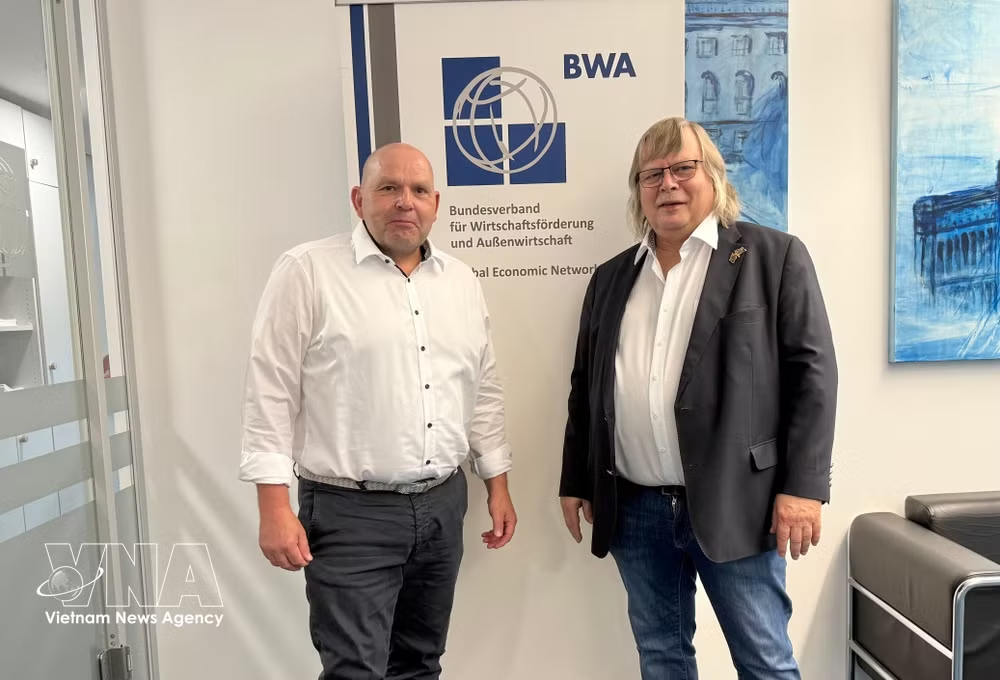
Heinrich Gerd-Witte (left), Advisory Board Member and Chairman of the Agriculture and Food Committee of the German Federal Association for Economic Development and Foreign Trade (BWA), and Hans-Joachim Radtke, a member of the Advisory Board and BWA’s trade representative for Vietnam and Chairman of the German-Vietnamese Innovation and Economic Forum (Photo: VNA)

Promising areas include smart rice farming, precision agriculture, sustainable aquaculture, water management, sensor technology, data platforms, AI and climate-resilient agriculture. Urban and indoor farming could also offer opportunities, especially in Hanoi and Ho Chi Minh City, where such models can help strengthen local food supplies while saving land and water.

They also emphasised the crucial role of intermediaries, particularly those proficient in both Vietnamese and German, in connecting the parties and bridging differences in culture and working styles.

The experts stressed that success should not be measured by how much German technology is brought into Vietnam, but by whether the two sides can develop solutions that work in Vietnam and deliver lasting benefits for farmers, the economy and the environment./.


VNA

See more

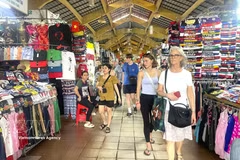
Ben Thanh Market in Ho Chi Minh City attracts a large numbers of domestic and international visitor.( Photo: VNA)

Vietnam targets 50 million international visitors by 2030

The Ministry of Culture, Sports and Tourism has outlined three scenarios for 2027–2030. Under the high-growth scenario, international arrivals would rise 15–18 percent annually to reach 45–50 million, while domestic tourism would reach around 160 million trips. Total tourism revenue is projected at 80–90 billion USD.

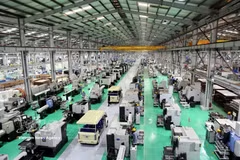
Factories and production facilities in the Chu Lai Open Economic Zone, Da Nang city, are equipped with modern production lines. (Photo: VNA)

Ready-built factories gain from new manufacturing FDI wave

Ready-built factories attracted 73% of new manufacturing FDI in northern Vietnam over the past two quarters, as foreign investment continued to surge at the region's industrial hubs during the first eight months of 2026. The trend points to growing demand for premises that can be put into operation quickly.

Vietnamese durian industry pivots from volume to value

Vietnamese durian industry pivots from volume to value

Durian has morphed from a high-value crop into a strategic Vietnamese export. But as output climbs and importing markets tighten rules on quality, food safety and traceability, the industry must pivot from volume growth to sustainable value chains, better quality and diversified markets.

A display area for Mid-Autumn Festival cakes at a supermarket (Photo: VNA)

Mid-Autumn Festival cake market heats up at affordable end

Industry insiders say competition is no longer just about the cake itself. Product quality, packaging, brand reputation, delivery services and personalisation are increasingly shaping consumer choices in a market crowded with both domestic and foreign players.

Minister of Foreign Affairs Le Hoai Trung (Photo published by VNA)

Vietnam, India set 25 billion USD trade goal

Vietnam and India agreed to make better use of complementary strengths, ease market access difficulties and facilitate business activities toward achieving the 25 billion USD bilateral trade target.

Delegates at the meeting between Vietnamese businesses operating in Cambodia and the Council for the Development of Cambodia (CDC) on September 14. (Photo: VNA)

Vietnamese businesses seek to expand investment in Cambodia

Vietnam currently has 223 investment projects in Cambodia with total registered capital of nearly 3.4 billion USD. Vietnamese companies operate in agriculture, particularly large-scale farming, finance and banking, telecommunications, aviation, processing, trade and services.

Children visit President Ho Chi Minh's hometown and learn about his childhood. (Photo: VNA)

Vietnam's tourism sector faces labour shortage

A 2026 survey by Hoteljob.vn found that nearly 90% of tourism businesses planned to recruit. In Ho Chi Minh City alone, 89.7% of businesses were hiring, while 71.8% said recruitment was difficult or very difficult. The biggest shortages were among frontline workers, particularly in housekeeping, engineering, food service, front-office operations, and kitchens.

Octopus processing for export at Huy Nam Company in An Giang province. (Photo: VNA)

New opportunities for Vietnam’s seafood exports

The Vietnam-EFTA Free Trade Agreement brings together two groups of highly complementary economies. EFTA members Switzerland, Norway, Iceland and Liechtenstein have strengths in technology, innovation, finance, clean energy and sustainable development, while Vietnam is one of Asia’s most dynamic economies and is emerging as a major regional manufacturing, trade and investment hub.

The saponin content of Lai Chau ginseng can reach as high as 23.85% in its natural state, a remarkably high level compared to many other ginseng species. (Photo: baolaichau.vn)

Lai Chau ginseng development gains momentum

Blessed with rare and distinctive ecological values, the northern mountainous province of Lai Chau is stepping up efforts to conserve and develop its native ginseng, with the medicinal plant expected to play a growing role in the forest-based economy and local livelihoods.