Vietnam strengthens cooperation with India’s leading technology partners

Both sides exchanged views on digital identification management, electronic authentication, biometrics, personal data protection and experience in implementing large-scale national digital services. The two sides also agreed to strengthen exchanges of experts and cooperation in technical and policy experience-sharing in the coming period.

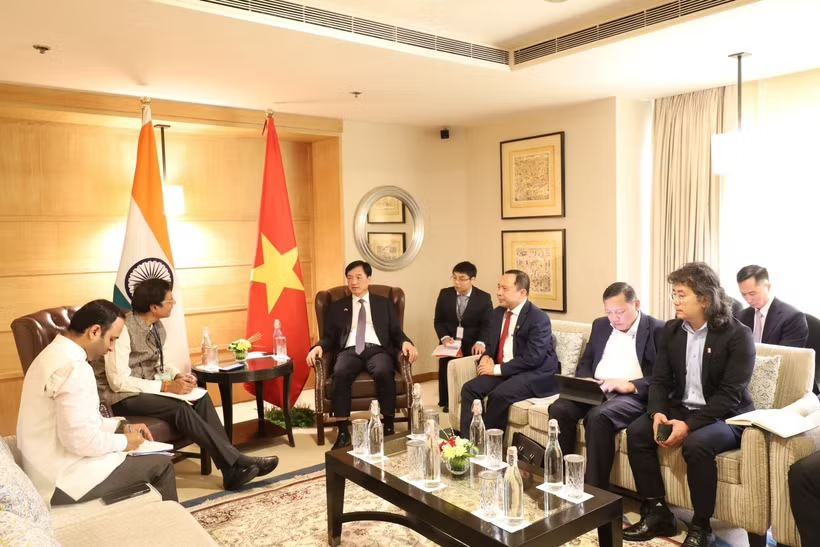
Politburo member Nguyen Duy Ngoc, who is also Secretary of the CPV Central Committee, Chairman of its Organisation Commission and standing deputy head of the Central Steering Committee for Science-Technology Development, Innovation and Digital Transformation, at a working sessions with leaders of the Indian Institute of Technology Madras (IIT Madras). (Photo: dangcongsan.vn)

New Delhi (VNA) – As part of the state visit to India by General Secretary of the Communist Party of Vietnam (CPV) Central Committee and State President To Lam, Politburo member Nguyen Duy Ngoc has held working sessions with leaders of the Indian Institute of Technology Madras (IIT Madras) and the Unique Identification Authority of India (UIDAI).

Ngoc, who is also Secretary of the CPV Central Committee, Chairman of its Organisation Commission and standing deputy head of the Central Steering Committee for Science-Technology Development, Innovation and Digital Transformation, appreciated IIT Madras’ experience in developing a research university model closely linked with industry and innovation.

He noted that such experience offers valuable reference points for Vietnam as the country accelerates efforts in science and technology development, innovation and digital transformation.

Professor V. Kamakoti, Director of IIT Madras, said the institute has produced 68 scientific publications with Vietnamese co-authors over the past six years and is currently cooperating with around 18 Vietnamese higher education institutions, including the Vietnam National University, Ho Chi Minh City and the Posts and Telecommunications Institute of Technology.

He expressed interest in expanding cooperation with Vietnam in education and research through joint training programmes, faculty and student exchanges, doctoral training and the possible development of articulation programmes between IIT Madras and Vietnamese universities.

He also proposed stronger collaboration in deep-tech innovation and startup ecosystems, aiming to support Vietnamese and Indian students and research groups in jointly developing ideas, establishing startups and expanding operations in both countries.

In addition, IIT Madras is studying the possibility of establishing a presence or cooperative facility in Vietnam in the future.

Ngoc, in turn, reaffirmed that Vietnam is promoting science-technology development, innovation and digital transformation. He expressed the country’s desire to deepen cooperation with IIT Madras and Indian partners in deep technology, high-quality human resources training and innovation ecosystem development on the basis of shared research, shared development and mutual benefit.

During a separate working session with the Vietnamese official, UIDAI leaders introduced the development and operation of the Aadhaar national digital identity ecosystem. The Aadhaar system currently provides 12-digit identification numbers to more than 1.4 billion people and supports electronic authentication, biometric verification and connectivity for public services, finance, healthcare, education and social welfare.

UIDAI representative emphasised that the core of the Aadhaar model lies not simply in developing a citizen application, but in building a foundational national digital identity infrastructure enabling government agencies, businesses and organisations to deliver unified, secure and low-cost digital services.

Ngoc praised India’s experience in developing national digital infrastructure to support the digital economy and digital society, particularly its platform-centred approach to promoting innovation and large-scale digital service delivery.

He noted that Vietnam’s study of the Aadhaar model highlighted several important lessons, including large-scale digital identification and authentication, the integration of identity, payment systems and public services, deployment on common devices, scalability, cost efficiency and the combination of technology solutions with legal frameworks for data protection.

During the discussions, both sides exchanged views on digital identification management, electronic authentication, biometrics, personal data protection and experience in implementing large-scale national digital services. The two sides also agreed to strengthen exchanges of experts and cooperation in technical and policy experience-sharing in the coming period./.


VNA

See more

According to Fortune’s latest list, Vinachem ranks 148th among Southeast Asia’s top 500 companies in 2026. (Photo: vinachem.com.vn)

Vinachem makes Fortune Southeast Asia 500 for the first time

According to Fortune’s latest list, Vinachem ranked 148th among Southeast Asia’s top 500 companies in 2026. The ranking is compiled using key financial indicators including revenue, profit and total assets, and covers enterprises from seven regional economies, namely Vietnam, Indonesia, Thailand, Malaysia, Singapore, Philippines and Cambodia.

Lien Khuong International Airport in the central province of Lam Dong (Photo: VNA)

Lien Khuong Airport expected to reopen in August

The project is invested by ACV, with a total investment of over 1 trillion VND (38 million USD), including the repair of the entire runway, taxiways, safety strips, and technical infrastructure and equipment to ensure flight operations.

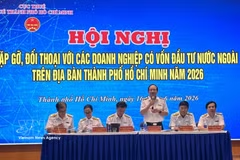
Representatives of Ho Chi Minh City's tax agency address concerns and clarify tax-related issues raised by the FDI business community. (Photo: VNA)

Ho Chi Minh City moves to ease tax hurdles for FDI firms

The Ho Chi Minh City tax agency said it will maintain regular dialogue with businesses, push ahead with administrative reform and digital transformation, and identify implementation bottlenecks to recommend policy adjustments, facilitating investment and business activities for FDI enterprises.

A workshop on the Halal market is held in Ho Chi Minh City on June 16, 2026. (Photo: VNA)

Growing Halal market offers opportunities for Vietnamese businesses

The Halal market is becoming a promising avenue for businesses in Ho Chi Minh City. With its well-developed manufacturing, trade and service ecosystem and dynamic business community, the city is well positioned to strengthen its role in regional and global Halal supply chains.

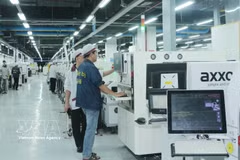
Wistron Infocomm Vietnam Co., Ltd, an FDI enterprise, has invested in Dong Van III Industrial Park of Ninh Binh province since 2021, creating jobs for more than 12,800 workers. (Photo: VNA)

Vietnam seeks to position itself as leading destination for foreign investment

A significant shift in the recently issued Resolution 10 is the move from a strategy of attracting “more capital” towards attracting “higher-quality FDI”. The objective is no longer limited to investment volume but extends to absorbing advanced technologies, increasing domestic value creation, strengthening innovation capacity and accelerating modernisation in the economy.

Enterprises must disclose to investors the issuance plan, legal and investment risks and the rights and obligations of issuers and bondholders. (Photo: VNA)

Vietnam tightens rules on corporate bond issuance

Under Decree No 200/2026/ND-CP, enterprises issuing bonds will continue to operate under the principle of self-borrowing, self-repayment and self-responsibility, meaning issuers are fully accountable for the efficiency of capital use, debt repayment capacity and any disputes arising from bond issuance, use of funds, and payment of principal and interest.

A performance on The Huc bridge of the temple as part of a nighttime tourism programme to discover the Ngoc Son temple on Hoan Kiem Lake, downtown Hanoi. (Photo: VNA)

Hanoi adopts framework to boost night-time economy development

The resolution encourages a wide range of cultural, artistic and tourism activities, including performances, exhibitions, film screenings, presentations of traditional and intangible cultural heritage, and other programmes held in public spaces, pedestrian streets, heritage sites, theatres, cinemas and cultural venues.

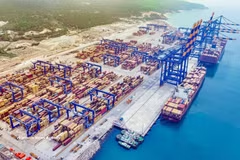
A cargo port in Thiruvananthapuram city, India (Photo: ANI/VNA)

Ample room remains for Vietnam–India logistics cooperation

The GTTCI expert noted that alongside logistics and integrated warehousing, e-commerce is expected to be a particularly high-growth sector in the coming years. He described it as a multi-billion-dollar market with significant untapped opportunities for cooperation between Vietnam and India.

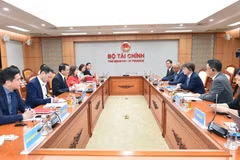
The meeting between Minister of Finance Ngo Van Tuan and Ambassador Julien Guerrier, head of the EU Delegation to Vietnam, on June 15. (Photo: thoibaotaichinhvietnam.vn)

Vietnam, EU enhance cooperation in green finance

Minister of Finance Ngo Van Tuan called on the EU to help facilitate Vietnamese firms' access to green finance, expand technical and financial assistance for green transition, and enhance cooperation in strategic technologies, innovation, digital finance and high-tech human resources development.

An overview of the working session between Deputy Finance Minister Tran Quoc Phuong and Kim Dongil, Director of ADB representing the Republic of Korea, Papua New Guinea, Sri Lanka, Taipei (China), Uzbekistan, Vanuatu and Vietnam. (Photo: Ministry of Finance)

Vietnam, ADB to advance strategic projects with strong economic impact

ADB has identified a pipeline of 27 projects for Vietnam through 2029, with total planned financing of approximately 4.6 billion USD. The projects focus on sectors that are among Vietnam’s priorities, including infrastructure, energy, urban development, agriculture and public sector management.