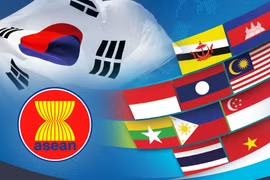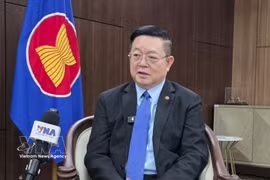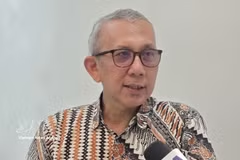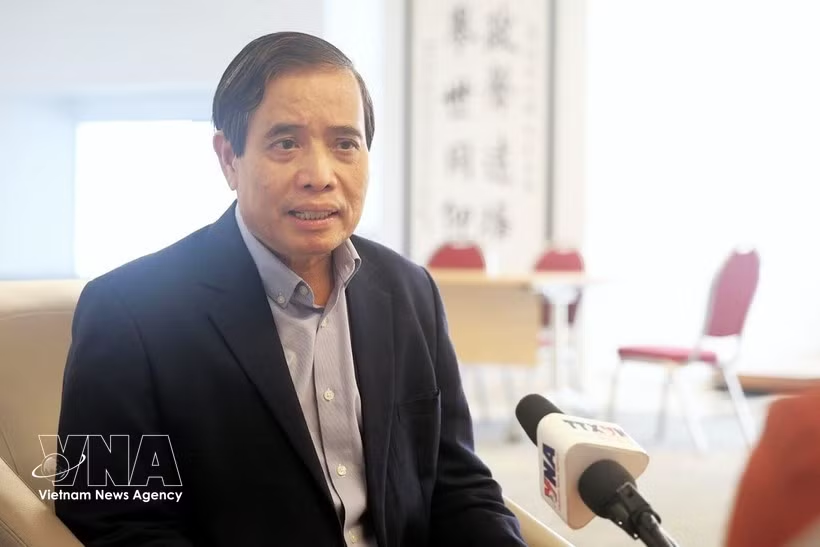
Singapore (VNA) – The ASEAN Future Forum (AFF) demonstrates Vietnam’s growing role and standing in promoting a more synergised and proactively connected ASEAN, said Professor Vu Minh Khuong of the Lee Kuan Yew School of Public Policy in Singapore.
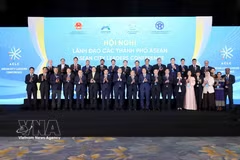
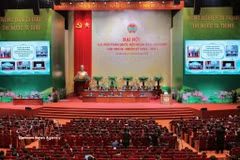
Speaking to Vietnam News Agency correspondents in Singapore ahead of the third ASEAN Future Forum, scheduled for June 9-10 in Hanoi, Khuong described the event as a major international forum bringing together senior leaders from the Association of Southeast Asian Nations (ASEAN). He noted that amid turbulent global political and economic changes, and the rise of Asia with its two major powers, China and India, the region is playing an increasingly decisive role in shaping the world's future.
In this context, ASEAN’s centrality is becoming more important than ever, while Southeast Asia is moving towards deeper integration and more sustainable development based on a shared vision.
According to the scholar, ASEAN includes countries that have become development models, such as Singapore, as well as rapidly advancing and strongly reforming economies like Vietnam, Indonesia and Malaysia. Even countries facing challenges, including Myanmar, are making efforts to integrate more deeply into the global community. These developments, he said, point to a bright future for ASEAN.
The professor stressed that one of the most encouraging developments is Vietnam’s increasingly proactive and influential role in shaping the future of Southeast Asia. Vietnam has actively integrated into the global economy and emerged as an important link in global technology supply chains.
Vietnam has also taken a proactive approach to the green transition and the adoption of digital technologies and artificial intelligence (AI). Therefore, hosting the AFF reflects the country’s important leadership role in shaping ASEAN’s future, he said.
Commenting on the forum’s agenda, Khuong said ASEAN could become a more dynamic economy and achieve faster growth if member states effectively harness their collective strengths and complementarities.
He suggested that ASEAN should deepen cooperation in digital technology, renewable energy, trade, tourism and, in particular, energy connectivity. The region could significantly strengthen its resilience to global uncertainties by building robust energy reserves, expanding renewable energy development and advancing the ASEAN power grid interconnection initiative currently under discussion.
Khuong also highlighted the potential of Vietnam and the Mekong sub-region as major food production hubs that could serve as strategic food reserves for both the region and the world.
According to the scholar, ASEAN should advance these priorities with a strong sense of responsibility and a forward-looking vision, while accelerating the application of science and technology and attracting greater global investment flows into the region. He affirmed that ASEAN is one of the world’s most vibrant economic regions with rapid growth potential in the years ahead and that Vietnam is poised to become one of its most outstanding success stories./.