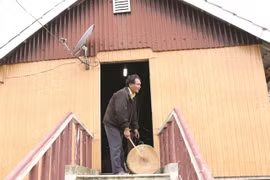
The house of a traditional drum craftsman in Doi Tam Village. (Photo: VNA)
They are often used to offer a warm welcome to guests, signal when schoolbegins or ends, and accompany musical performances at weddings, longevitycelebrations, and funerals.
Depending on the event, drums could either create an atmosphere of joyfulunion or sad separation.
When festival drumbeats fill the air, farmers put on their best clothes andhead out to celebrate. Drums have become a key part of many communityactivities held throughout the length and breadth of the country.
Though drums are readily found in traditional Vietnamese culture, thosewith the best quality are only made in a few areas, among which is ancient Doi Tam village in the northernprovince of Ha Nam.
Located at the foot of scenic Doi Mountain in Duy Tien district, thevillage is renowned not only for making drums for more than a thousand yearsbut also for creating the largest 'thunder' drums in the country, with two ofthe biggest played at festivals celebrating the 1,000th anniversary of Thang Long – Hanoi capital in 2010.
Doi Tam is a long-standing traditional craft village that complements thetypical features of northern Vietnamese culture via its drums.
All villagers, from old to young, know the legend of their ancestors - thetwo brothers Nguyen Duc Nang and Nguyen Duc Ban.
The legend says that when the two heard about Emperor Le Dai Hanh’s return to their village to hold a royal ploughingceremony to promote agriculture, they immediately chopped down the biggestjackfruit tree in their garden and killed the biggest buffalo to get wood andleather to make a huge drum in welcome.
Thus, in the spring of the 7th year of Emperor Le Dai Hanh’s reign (987), an unforgettable ploughing ceremony washeld in Doi Tam to the unique drumsounds from Nguyen brothers.
The resounding beat of their drum saw the two honoured as “Trang Sam” (Thunder Masters), inrecognition of their skills in making the best large drums.
Throughout history, drum making has always played an important role incommunal life in Doi Tam.
Its drums are special as they are used for a host of different purposes,such as worshipping, folk art performances, and transmitting information.
The village’s 700 households include 600 that are skilled in drum-making,with four recognised as master artisans.
Making a good drum requires great care and expertise in selecting andassembling materials. Precision is key in creating the right sound for each,and the task often involves secrets handed down through the generations.
Le Ngoc Hung, one of the artisans and also the owner of a major drumproduction workshop in Doi Tam, saidhis facility had produced tens of thousands of drums of all kinds for bothlocal sale and export.
He emphasised the importance of selecting the best materials.
“The wood for the body of the drum must come from an old jackfruit treewith a curvature that matches the requirements of each type of drum,” heexplained. “The buffalo skin used for the drumhead must be scraped clean andthen stretched and dried, so it is tough and will not rot as time goes by.”
Beyond materials, he said, a superior-quality drum very much depends on theskill of the artisan, as different drums produce different sounds.
Hung is also focusing on training the younger generation in the village, topreserve the traditional craft.
The most important thing about drum making, he believes, is not thecraftsmen’s reputation but their heart and soul.
Craftsmen not only need to be enthusiastic and creative and possess a senseof exploration, but also be keenly aware of the need to preserve the villagecraft by motivating the generation that follows.
Meanwhile, artisan Pham Chi Khang,chairman of the village’s Association of Doi Tam Drum Making and Trading, said that assembling the drum barrel is the mostimportant stage.
“The biggest drum I ever made was a royal drum 3.1 metres high and 2.35metres in diameter,” he recalled. “The largest drum in Southeast Asia was madeby Doi Tam villagers. The larger thedrum, the more precision required and the more time needed.”
If there is ever a flood, fire, or death in the village, a drum is used asa call to arms or to announce a period of mourning.
During Vietnam’s resistance warsagainst foreign invaders, the sound of a drum roused soldiers into actionaround the countryside.
A drum is also used as a mark of respect during cheo (traditional opera) or ca tru (ceremonial singing) performances, with a connoisseur hitting the side ofthe drum with a drumstick at appropriate moments to express his appreciation.
Tran Dinh Tien, head of the Culture and Information Section in Duy Tien district, said that, in the past,drums were also used in combat against foreign invaders.
“Drumming attracts people to participate in community activities,” he said.“The drum is an indispensable part of festivals because it rouses the spiritsof the ancestors.”
Doi Tam produces many types of drums, ranging from those for cheo singing to those for festivals orschools, in sizes ranging from 20cm to 2m in diameter. Village craftsmen madethe largest drum in the country, which is now at the Temple of Literature in Hanoi and is more than 2m in diameter,2.65m in height, and 10 cubic metres in volume.
According to artisan Khang, the village produces about 25 different typesof drums. Those for rituals or sacrifice rites are called spiritual or worshipdrums, and those used at community festivals are called festival drums, whilethose used at pagodas differ from those used in temples or communal houses.
“For example, a drum used in a communal house should be big,” he explained.“Its sound represents the tutelary god who rules the village. The drum in atemple, meanwhile, should be of medium size. And a pagoda drum can be small.”
A drum is made in three stages: leather tanning, barrel making, anddrumhead stretching. Craftsmen use buffalo skin for the drumhead. They firstshave the buffalo skin until it becomes quite thin, and then dry it in the sun.The barrel is made from jackfruit wood. Stretching the drumhead is the mostdifficult task, because it requires skill on the artisan’s part to assess thesound being created.
According to Khang, drum makers choose a certain pattern to suit each typeof drum.
“The pattern will also depend on the drum’s purpose,” he said. “Forexample, clouds are often drawn on festival drums. For pagoda, temple, orcommunal house drums, common patterns include dragon-shaped clouds. Templedrums may also have phoenixes. The patterns on drums used in art troupes willhave brocade designs or something similar to the motifs of bronze drums. Drumsfor cultural events, meanwhile, are decorated with cranes. The drumheads forfestival drums must also, of course, have light rays breaking through tosymbolise the world.”
The village has also formed a drumming team with dozens of members thatperform at festivals nationwide.
In the decade since its establishment, the team has become widely known forits jubilant sound, which at times resembles troops setting off for battle.
There are 62 companies involved in drum production and trade in Doi Tam, which help improve localliving standards.
Thanks to the traditional occupation, no one in the village is unemployedand local living standards have indeed been rising in recent years.
“In 2007, Doi Tam was one of thefirst 12 handicraft villages granted the title ‘Outstanding Craft Village of Vietnam’ by the Vietnam Craft Village Association,” Khang said.
“Other villages also make drums but they can’t match the characteristics ofours. Many unsuccessfully try to imitateour style.”/.
VNA