Hanoi proposes pillars of cooperation with Moscow, seeks stronger BRICS urban connectivity

An official suggested the Hanoi People’s Council and the Moscow City Duma increase experience-sharing in institutional perfection, smart urban governance and digital transformation, particularly in power decentralisation, budget management and policy implementation oversight.

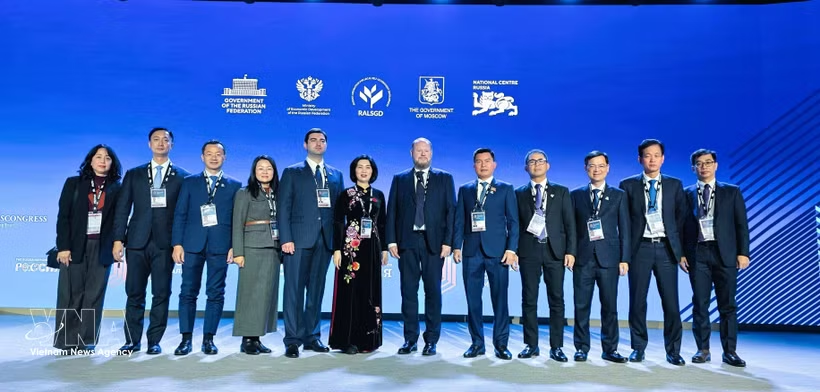
Officials pose for a group photo at the International Municipal Forum 2026 in Moscow, Russia. (Photo: VNA)

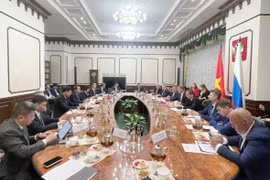
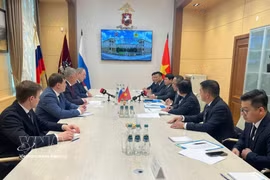
Moscow (VNA) – Hanoi has proposed three key pillars of cooperation with the Duma of Russia's Moscow city, focusing on experience sharing, urban development, and cultural and people-to-people exchanges, while seeking to strengthen connectivity among BRICS cities.

The proposals were put forward by Phung Thi Hong Ha, Chairwoman of the Hanoi People’s Council, at the International Municipal Forum 2026 held in Moscow on November 23–24 under the theme “Sustainable Urban Transformation: Responding to Global Challenges”. She led a Hanoi delegation to attend key activities of the forum.

During her remarks at a panel discussion of the forum, Ha highlighted the traditional friendship between Vietnam and Russia, as well as the close and trusted cooperation between their capitals.

Building on the momentum generated by the official visit to Vietnam by Chairwoman of the Federation Council of the Federal Assembly of Russia Valentina Matviyenko on November 11–13, Ha underscored the important role of people-elected bodies in policymaking, resource allocation and supervision of policy enforcement to ensure that decisions serve the people's interests.

In line with the Hanoi Master Plan and special mechanisms under the 2026 Capital Law, she suggested the Hanoi People’s Council and the Moscow City Duma increase experience-sharing in institutional perfection, smart urban governance and digital transformation, particularly in power decentralisation, budget management and policy implementation oversight.

They should also step up exchanging experience in applying digital technologies, AI and big data to build modern and people-centred governance, she said.

Hanoi also hopes to learn from Moscow’s experience in green and sustainable urban development, especially public transport, urban railways linked to spatial planning, green spaces, clean energy, emissions reduction and heritage preservation, Ha stressed.

Cultural, educational and people-to-people exchanges should also be expanded, building on the success of the Hanoi Cultural Days in Moscow held in May 2026, she went on, adding that the two sides should enhance links among their educational and research institutions, along with young people, while promoting the role of the Vietnamese community in Moscow and the Russians in Hanoi as bridges of friendship.

Beyond bilateral cooperation, Ha affirmed that Hanoi, as the capital of a BRICS partner country, stands ready to actively participate in the Parliamentary Movement of the BRICS Capitals, share experience and work with Moscow to advance practical initiatives for sustainable urban development.

Talking to the Russian media on the sidelines of the forum, the official said Hanoi and Moscow hold considerable potential and complementary advantages to expand tourism cooperation, promote people-to-people exchanges and showcase their cultural identities and tourist attractions.

In an interview granted to the Vietnam News Agency, Ha also stressed Hanoi’s wish that BRICS capitals will share experience in developing mechanisms and policies on power decentralisation, capital mobilisation, resource allocation and implementation supervision.

She called for stronger application of digital technologies and improved accountability to build modern, transparent, efficient and people-centred urban governance.

The forum was jointly organised by the Russian Government, the country's Ministry of Economic Development, the All-Russian Association for the Development of Local Self-Government, the Moscow administration and the Roscongress Foundation.

Its agenda covered five major areas, including the economy and innovation, sustainable urban development, international relations, human resources and youth initiatives./.

VNA
See more

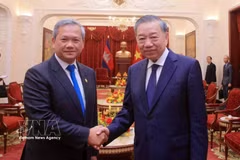
General Secretary of the Communist Party of Vietnam Central Committee and President To Lam (R) receives Cambodian Prime Minister Hun Manet in Hanoi on November 28 afternoon. (Photo: VNA)

Top Vietnamese leader receives Cambodian Prime Minister

General Secretary of the Communist Party of Vietnam Central Committee and President To Lam reaffirmed that Vietnam consistently attaches great importance to and gives high priority to consolidating and nurturing its good-neighbourliness, traditional friendship, comprehensive cooperation and long-term sustainability with Cambodia.

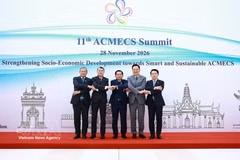
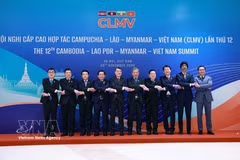
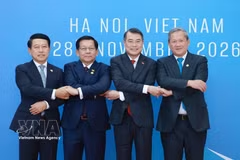
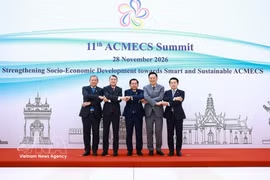
From left: Cambodian Prime Minister Hun Manet, Prime Minister Le Minh Hung, Myanmar President Min Aung Hlaing, Thai Prime Minister Anutin Charnvirakul, and Lao Prime Minister Saleumxay Kommasith pose for a group photo at the 11th ACMECS Summit. (Photo: VNA)

PM Le Minh Hung proposes three key priorities for ACMECS cooperation

Addressing the summit, Prime Minister Le Minh Hung reaffirmed Vietnam’s commitment to active participation in and contributions to Mekong subregional cooperation, particularly ACMECS, describing the mechanism as the only cooperation framework initiated and owned by all five Mekong countries.

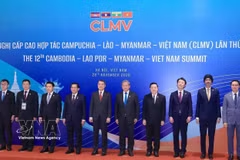
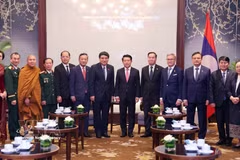
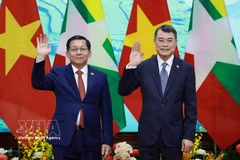
Vietnamese Prime Minister Le Minh Hung (fifth from left), Myanmar President Min Aung Hlaing (fourth from left), Lao Prime Minister Saleumxay Kommasith (third from left), Cambodian Prime Minister Hun Manet (sixth from left), ASEAN Secretary-General Kao Kim Hourn (seventh from left) and heads of guest delegations at the 12th CLMV Summit in Hanoi on November 28, 2026 (Photo: VNA)

Joint Statement of the 12th CLMV Summit

CLMV leaders reaffirmed their unwavering commitment to the principles of CLMV cooperation, embracing traditional friendship, good neighbourliness, mutual benefit, mutual respect and mutual support among the CLMV countries, and non‑interference in one another’s internal affairs.

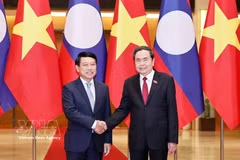
Standing Member of the Communist Party of Vietnam (CPV) Central Committee’s Secretariat Tran Cam Tu (R) meets with Lao Prime Minister Saleumxay Kommasith in Hanoi on November 28. (Photo: VNA)

Lao PM believes ties with Vietnam will grow stronger

The senior Vietnamese Party official congratulated Saleumxay Kommasith on his election by the 10th Lao National Assembly as Prime Minister, showing confidence that he will continue to make important contributions to Laos’ national construction and development and to nurturing the special Vietnam–Laos relationship.

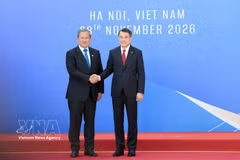
Prime Minister Le Minh Hung (right) welcomes Cambodian Prime Minister Hun Manet at the 12th CLMV Summit in Hanoi on November 28, 2026. (Photo: VNA)

Vietnam, Cambodia to further enhance bilateral cooperation mechanisms

Highlighting the importance of economic connectivity, both sides pledged to facilitate cross-border trade, investment, and goods circulation, capitalise on market opportunities as well as each country’s strengths, and strive to raise bilateral trade to the 20 billion USD target at an early date.

From left: Lao Prime Minister Saleumxay Kommasith, Myanmar President Min Aung Hlaing, Vietnamese Prime Minister Le Minh Hung, and Cambodian Prime Minister Hun Manet at the welcome ceremony for leaders attending the 12th CLMV Summit in Hanoi on November 28, 2026 (Photo: VNA)

PM Le Minh Hung welcomes leaders to 12th CLMV Summit

As Chair of the CLMV cooperation mechanism for 2026, Vietnam is hosting the 12th CLMV Summit and, in coordination with Myanmar, the current Chair of the Ayeyawady-Chao Phraya-Mekong Economic Cooperation Strategy (ACMECS), the 11th ACMECS Summit.

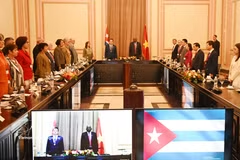
The third session of the Inter-Parliamentary Cooperation Committee between the National Assembly of Vietnam and the National Assembly of People's Power of Cuba in Havana (Photo: VNA)

Vietnam, Cuba reaffirm commitment to strengthening parliamentary ties

Vietnamese NA President Tran Thanh Man expressed his wish that the two legislatures will continue to play a proactive and responsible role alongside their governments to turn high-level agreements and commitments into tangible and practical outcomes for the benefit of both peoples.

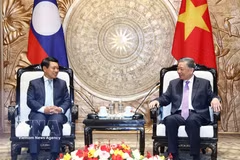
General Secretary of the Communist Party of Vietnam Central Committee and President To Lam (R) receives Lao Prime Minister Saleumxay Kommasith in Hanoi on November 27. (Photo: VNA)

Top Vietnamese leader receives Lao Prime Minister

General Secretary of the Communist Party of Vietnam Central Committee and President To Lam congratulated Saleumxay Kommasith on being elected Prime Minister by the 10th National Assembly of Laos, stressing that his first official visit to Vietnam in the new capacity carries important political significance, as it will help consolidate political trust, translate high-level commitments and into concrete actions, and provide fresh impetus for the bilateral relationship to develop in an increasingly profound, substantive and effective manner.

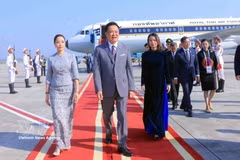
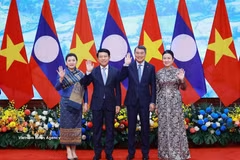
Prime Minister Le Minh Hung (second from right) and his spouse pose for a photo with Lao Prime Minister Saleumxay Kommasith and his spouse in Hanoi on November 27. (Photo: VNA)

Vietnam, Laos bolster comprehensive cooperation, strengthen strategic cohesion

Welcoming PM Saleumxay and his wife on his first official visit to Vietnam in his capacity as Prime Minister, PM Hung stressed that the trip is of important significance in further deepening the great friendship, special solidarity, comprehensive cooperation and strategic cohesion between Vietnam and Laos.

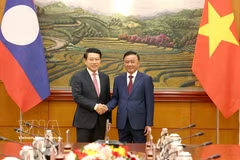
National Assembly President Tran Thanh Man (R) welcomes Lao Prime Minister Saleumxay Kommasith on November 27 evening. (Photo: VNA)

NA President meets with Lao Prime Minister

NA President Man highlighted PM Saleumxay’s first official visit to Vietnam in his new capacity as Prime Minister, saying it is a vivid demonstration of the special relationship between Vietnam and Laos. The visit, he said, will provide fresh momentum for strengthening the two countries’ great friendship, special solidarity, comprehensive cooperation and strategic cohesion between their two Parties, States and peoples.