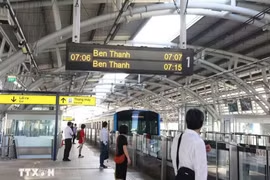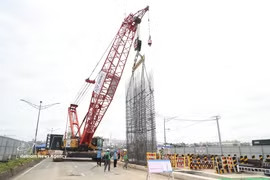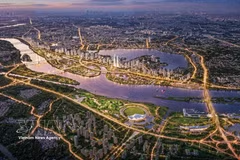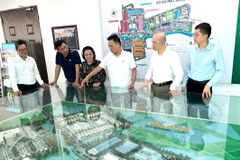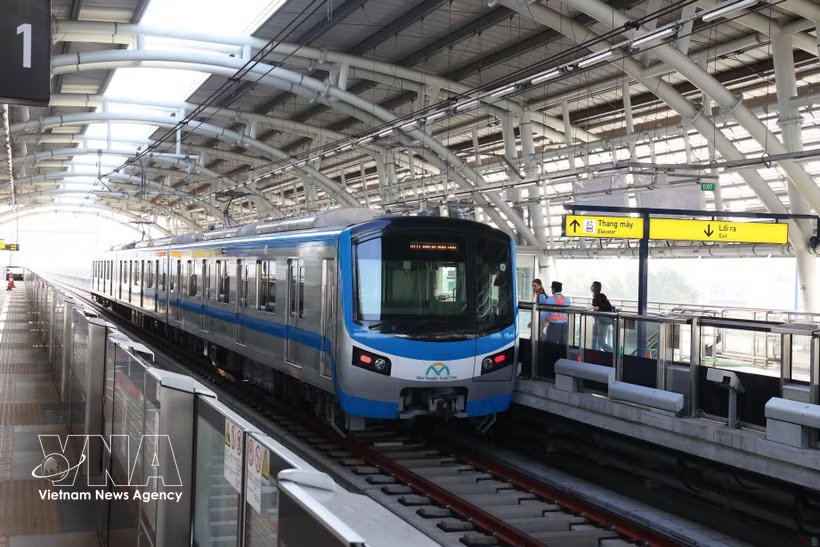
Ho Chi Minh City (VNA) – Ho Chi Minh City is not simply aiming to build 255km of metro lines by 2030; it is using the network as a backbone to reorganise urban space, with transit-oriented development (TOD) serving as a mechanism to turn transport infrastructure into a source of development resources.
To date, the southern economic hub has commenced construction or broken ground on three of the six projects and works included in the list of priority investment routes for the 2026–2030 period, while continuing to complete procedures for the remainders.
Recently, the municipal steering committee for the development of the railway network agreed in principle to add two urban railway lines, Thu Dau Mot–Ho Chi Minh City and Tham Luong–An Ha–Northwest Urban Area, to the list of priority investments to be completed during this period.
The city targets the completion of 255km of urban railways by 2030 and will continue to invest in seven additional lines with a view to raising the total length to 532km by 2035.
Metro opens up new development space
As an expert in planning and architecture, Dr Ngo Viet Nam Son, Chairman of NgoViet Architects & Planners, said the city’s target is highly ambitious, but the pace of implementation remains a major challenge.
The 19.7km Ben Thanh–Suoi Tien metro line took nearly 20 years to reach basic completion, while the metropolis is now targeting the completion of 255km in less than 10 years.
This reality shows that, with the 255km target for 2030, Ho Chi Minh City is not merely expanding its network; it is actually facing the task of restructuring urban transport within a very short cycle, Son noted.
Dr Huynh Van Sinh of the Ho Chi Minh City Cadre Academy said the target does not stem from a subjective desire of the municipal authorities, but from a series of consistent decisions by the central authorities, including Politburo Resolution No. 31-NQ/TW on orientations and tasks for the development of Ho Chi Minh City to 2030, with a vision to 2045; National Assembly Resolution No. 188/2025/QH15 on piloting specific and exceptional mechanisms and policies for the development of urban railway networks in Hanoi and Ho Chi Minh City; and, most recently, Politburo Resolution No. 27-NQ/TW, dated August 28, 2026, on the development of regions and the organisation of national development space in the new period.
Sinh said that the greater the ambition, the greater the accountability. Land-use planning, population distribution and site-clearance capacity must precede or run in parallel with infrastructure development. Otherwise, there is a risk of repeating the difficulties that caused the construction of Metro Line No. 1, Ben Thanh–Suoi Tien, to take longer than originally expected.
“This is a lesson that must not be repeated on a 255km scale,” he said.
The Ho Chi Minh City Party Committee has assigned the municipal People’s Committee to urgently draw up a detailed plan for implementing eight urban railway projects set for completion during the 2026–2030 period.
The city is also accelerating the identification of station locations, route directions and the boundaries of urban development areas under the TOD model for the 2026–2030 priority lines and seven others scheduled for completion before 2035.
According to Son, metro development in the past focused primarily on improving transport connectivity. In the new period, however, the TOD ecosystem needs to be developed in parallel with metro expansion, thereby turning urban railway lines into backbones for new urban space development.
Mobilising substantial resources
To achieve the 255km railway target, the city has determined that it must flexibly utilise multiple sources of funding, including the central budget, local budget, public investment, public-private partnerships (PPP) and other lawful resources.
Politburo Resolution No. 27-NQ/TW identifies infrastructure development as a strategic economic sector, creating a large market to develop domestic production capacity. The resolution calls for mechanisms to unlock and activate social resources for development investment, with priority given to private and PPP investments.
Sinh said TOD is an important mechanism for combining public and private resources. The State will undertake tasks that the private sector finds difficult to handle such as compensation, support and resettlement, land acquisition, urban landscape improvement and land availability. The private sector could then participate in developing housing or commercial and service facilities around railway stations through land-use rights auctions or other appropriate mechanisms.
The recently passed Urban Development Law gives the Ho Chi Minh City People’s Council authority to establish urban development policies in TOD areas, thereby creating an additional mechanism for mobilising land resources and reinvesting them in infrastructure, he noted.
Sinh said that when metro and TOD are implemented in a coordinated manner, the appearance of Ho Chi Minh City will undergo significant changes. Development space then could expand along metro corridors, forming new urban centres in Thu Duc, Binh Chanh, Hoc Mon and Cu Chi, while strengthening connections with areas in former Binh Duong and Ba Ria-Vung Tau provinces.
The development of public transport will also help gradually reduce dependence on private vehicles, improve the environment and enhance the quality of urban life. At the same time, land values around railway stations are expected to increase, creating additional resources for reinvestment in infrastructure, he added./.
See more
Vietnam’s hiring outlook to see strong growth in Q4
In Vietnam, among 285 businesses surveyed, 52% expected to increase hiring in Q4, 16% planned to reduce hiring, while 32% intended to maintain their current workforce levels, according to the latest ManpowerGroup Employment Outlook Survey.
16 countries, territories join international fire safety exhibition
The International Fire Safety & Rescue Vietnam – Secutech Vietnam 2026 opened in Hanoi on September 9, featuring 500 booths by 350 domestic and international enterprises and organisations, representing 480 brands from 16 countries and territories.
Young generation injects new vitality into Vietnam-France relations: French professor
Vietnam’s growing development and achievements in diplomacy, economy and culture are creating a strong and lasting attraction among French people, constituting a genuine form of soft power, said Professor of contemporary history Pierre Journoud of University of Montpellier Paul Valéry.
‘Small bricks’ help strengthen Vietnam-France ties
Dr. Gildas Tréguier, Secretary-General of the France-Vietnam Health Federation (FSFV), said the visit comes as Vietnam is opening further to the world and entering a new stage of development, creating greater demand for experience sharing and closer cooperation with international partners, including France. After nearly 40 years of involvement in medical cooperation programmes with Vietnam, he said bilateral ties have been built not only through major events and government-level agreements, but also through the contributions of generations of people.
Vietnamese community in Czech Republic shows strong support for homeland’s seas and islands
The Hoang Sa-Truong Sa Club's activities reflect the deep affection of Vietnamese people in the Czech Republic for their homeland, help strengthen the bond between the Vietnamese community abroad and the country, and foster a sense of responsibility and love for Vietnam’s seas and islands.
📝OP-ED: Red River urban planning: Transparency key to building public consensus
Hanoi began collecting public opinions on September 7 on the comprehensive adjustment of the master plan, at a scale of 1:5,000, covering the section from Hong Ha Bridge to Me So Bridge. Community consultation will last 20 days from the date the planning documents are made public.
Clear, stable mechanisms needed to tap OV resources: Vietnamese-Canadian entrepreneur
OVs offer more than capital; they also bring knowledge, technology, management experience, and international market access. Vietnam needs to advance high technology, digital transformation, artificial intelligence, green economy, environmental protection, education and training.
Ho Chi Minh City steps up enforcement to address outstanding IUU fishing issues
Municipal authorities will mobilise their entire apparatus for the work while clearly assigning responsibilities to each individual and head of agency, contributing to efforts to have the "yellow card" warning removed and promote sustainable fisheries development.
Vietnamese language preserved across globe
In the new context, Politburo Resolution No. 23-NQ/TW, dated August 2, 2026, continues to place the preservation of the Vietnamese language within the strategic vision of mobilising resources from the Vietnamese community abroad and promoting Vietnamese cultural values around the world.
Leveraging overseas Vietnamese resources for Vietnam-France ties
As Vietnam enters a new era of prosperous and harmonious development, top leader To Lam's official visit to France will significantly contribute to the special dynamics of bilateral relations while fostering shared commitments to international peace, security, and stability.
Overseas Vietnamese ready to contribute to national transformation
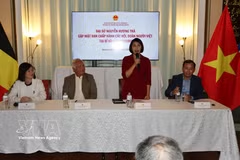
Affirming that overseas Vietnamese are an integral part of the nation and partners in its development and creation, Vietnamese Ambassador to Belgium and Head of the Vietnamese Mission to the European Union (EU) Nguyen Huong Tra pledged to listen to them openly and responsibly, and convey their recommendations to authorities at home.
Phu Tho: 200kg bomb safely relocated, detonated
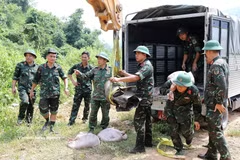
According to a report by the Phu Tho Military Command, local residents spotted the bomb on August 31 in the Da River after the river water receded, exposing it beneath mud and soil on the riverbed. The bomb remained intact, including its fuse, and was located about 300m from a residential area.
Ca Mau tightens control, determined to fully address IUU fishing violations
Ca Mau is determined to eliminate IUU fishing activities. In particular, the province’s highest priority is to completely stop local fishing vessels from entering foreign waters, Vice Chairman of the provincial People’s Committee Le Van Su.
Vietnam Buddhist Sangha calls for support for flash flood victims in Nepal-China border area
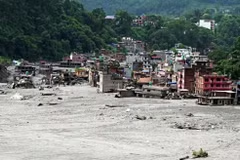
The Sangha said the support and solidarity of monks, nuns, lay Buddhists and followers nationwide are urgently needed to help ease the victims’ hardship, provide timely encouragement and demonstrate solidarity with fellow Buddhists affected by the disaster.
Vietnamese lecturer honoured as 2026 Vietnamese Language Ambassador abroad
On the occasion of the Day honouring Vietnamese language, Nguyen Thi Lien Huong urged families and young Vietnamese abroad to make language preservation part of everyday life, with parents and grandparents maintaining the habit of speaking Vietnamese with children.
Hanoi studies underground pedestrian route linking Opera House with nearby spaces
The study area covers about 32.51ha in Hoan Kiem and Cua Nam wards, bounded by Cau Go street to the North, Hang Trong street to the West, Hai Ba Trung street to the South, and Ly Thai To and Tran Quang Khai streets to the East.
Quang Ninh 2030: Ambitious targets for a breakthrough
These objectives reflect the principle that economic development must not become detached from living standards; rather, the benefits of growth should create opportunities for all residents to share in its achievements.
Shift to data-driven administrative procedures needs acceleration
Under a draft decree replacing Decree 63, authorities will have to proactively pull information from databases and records for informational or technical procedures. Applicants would no longer be required to resubmit documents, and certification or information requests could not be turned into discretionary licensing through an “ask – give” mechanism.
Mexican journalist praises Vietnam’s profound transformation
According to the article, Vietnam’s progress over the past decades has turned President Ho Chi Minh’s aspiration for a country that would be more dignified and more beautiful into reality in ways that have far exceeded what was initially envisioned.
Vietnamese, Korean journalists step up exchanges in digital era
Vietnam always regards the Republic of Korea (RoK) as a country with a highly developed press sector and hopes to learn more from its Korean colleagues, said Le Quoc Minh, Editor-in-Chief of Nhan Dan Newspaper and President of the VJA.