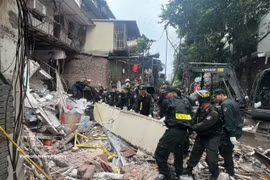
Hanoi (VNA) - General Secretary of the Communist Party of Vietnam Central Committee and President To Lam on November 25 sent condolences to families of those killed and sympathies to the injured in a suspected gas explosion on Nguyen Van Tuyet street in Hanoi. He told the municipal authorities and relevant agencies to quickly stabilise housing and daily life for affected residents and tighten fire-safety checks in residential areas.
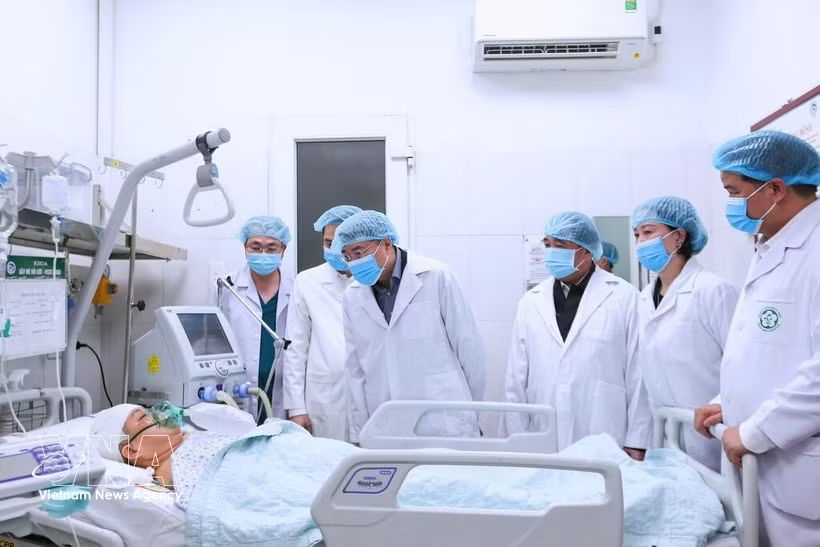
The blast struck Dong Da ward on November 24 morning, killing seven people and injuring nine. Prime Minister Le Minh Hung, Secretary of the Hanoi Party’s Committee Tran Duc Thang, Chairman of the municipal People’s Committee Vu Dai Thang and Minister of Health Dao Hong Lan visited Saint Paul General Hospital and Hanoi Medical University Hospital to comfort the injured and the victims’ families.
Under a dispatch signed on November 24 by Vice Chairman of the municipal People’s Committee Do Anh Tuan, the city police chief would lead the response, investigation and accountability review in coordination with the Chairman of the Dong Da ward People’s Committee.
The Department of Construction would coordinate with Dong Da ward authorities to relocate and temporarily house more than 100 affected households at the Thuong Thanh resettlement area on Ly Son street in Viet Hung ward.
Even as Hanoi authorities treat victims, clear damage and investigate the cause, social media has turned into an “online trial” of the gas stove.
The fire and explosion risk from gas stoves is real. But gas is embedded in modern life worldwide, and accidents can be sharply reduced when safety rules are enforced.
Worldometer data show that global gas demand hit a record above 4,200 billion cu.m in 2025. The top five users, including the United States at 22.1%, Russia 11.8%, China 10%, Iran 6.2% and Canada 3.3%, accounted for 53.4% of demand.
In Vietnam, liquefied natural gas (LPG) remains a common cooking fuel for households and eateries, even as urban users switch to electric and induction cookers.
Gas cooking is also widespread across Asia, including China, Japan and Southeast Asia.
Gas stoves offer instant heat control, suit specific dishes, work with most cookware, cost less upfront, last longer, are easy to repair and are not exposed to power cuts.
Risk controls are manageable. New gas stoves include flame-out auto shut-off to prevent leaks, and the distinctive odor of gas makes leaks easier to detect.
The Ministry of Public Security’s fire and rescue police said genuine cylinders are made of load-bearing steel and do not spontaneously explode under normal conditions. Most incidents trace back to complacency, such as unlocked valves, gas escaping after flames go out, or substandard equipment such as old refilled cylinders and unchecked hoses cracked or gnawed by rodents.
Safe practice means keeping cylinders upright and ventilated, away from pits and closed holes; placing the stove 1–1.5m from the cylinder or behind a partition and at least 15–20cm from walls, watching the stove while cooking, opening doors or running ventilation, and checking hoses and locking valves before shutting off the stove. If gas is smelled, one should close the safety valve if safe, avoid switches or spark-producing devices and evacuate immediately.
Vietnam regulates gas stoves and LPG through technical standards, trading and import rules and fire-safety requirements.
Restaurants using industrial gas systems or multiple cylinders face stricter fire-safety controls and design standards under TCVN 7441:2004 for LPG supply systems.
Rules only work if firms, users and the broader public cooperate, under the principle that safety for everyone is safety for oneself. Public information and whistleblowing on violations are part of that social layer.
After the November 24 blast in Dong Da ward, social media has also produced offensive behaviour that angers the public and obstructs the response.
Hostile forces have seized the moment to distort the situation, attack the authorities and agencies and exaggerate the damage while ignoring relief efforts.
Others spread fake news, splice images, inflate casualty figures and stir confusion to draw engagement.
Some have exploited victims’ pain to sell goods, including unproven “gas-cylinder safety devices” or impersonated relatives to profit from charity.
Hanoi police urged the online public to rely only on official media and government portals and not to circulate sensitive images or videos of victims.
The key is to separate a single incident from inferences dressed up as root cause. Without an official finding, accurate lessons cannot be drawn. Calm, support for victims’ families, joint relief and resistance to false information are what matter now./.
VNA