Offerings for a groundbreaking ceremony (Photo: VNA)
Hanoi (VNA) - Vietnam boasts a rich agricultural heritage, with festivals, rituals, and offerings deeply rooted in its civilization and agricultural practices. Several key festivals hold great importance, occurring in the early days of Spring.
Groundbreaking Ceremony
In Vietnamese culture, before engaging in agricultural activity that involves the land in early year, it is customary to seek permission from the Earth God through the groundbreaking ceremony.
Each year, following the third day of the first Lunar month (after Tet holiday), villages conduct the Groundbreaking Ceremony to commence digging activities. Elders and officials are chosen as priests and worshippers to pay homage to the Earth God, with offerings such as incense, betel, wine, paper clothing, and paper money offerings.
Upon completion of the Groundbreaking Ceremony, villagers are permitted to work with the land.
 Practitioners pray to seek permission from the Earth God (Photo: VNA)
 A groundbreaking ceremony (Photo: VNA)
Crop God Ceremony (Ploughing Ceremony)
Crop God, considered the pioneering figure who introduced farming techniques, including the creation of plows, was also the first to conduct the Ploughing ceremony.
The Crop God Festival is a ritual held to invoke blessings for a bountiful harvest and successful farming endeavors.
 A parade at a Crop God ceremony (Photo: VNA)
Thuong Nguyen Festival (The First Full Moon Festival)
The Thuong Nguyen or Nguyen Tieu Festival is observed on the full moon day of the first lunar month, with both the Royal Court and the general populace coming together to honor Buddha on this occasion.
According to ancient customs, it is believed that Buddha descends upon pagodas during the full moon day of the first lunar month to witness the devotion of Buddhist followers. Consequently, pagodas are usually crowded with worshippers during this period.
 Many people visit pagodas in Ho Chi Minh city on the first lunar full moon day (Photo: VNA)
 Visitors pray for peace at Tran Quoc pagoda (Photo: VNA)
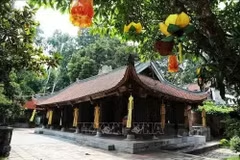
 Tran Quoc pagoda (Photo: VNA)
 A ceremony is held at Bo De pagoda in Da Nang on the first full moon day (Photo: VNA)
 Residents in Hanoi pray at Tay Ho Temple (Photo: VNA)
 Residents and visitors attend a ceremony in Phuc Khanh Pagoda in Hanoi (Photo: VNA)
Khai ha ceremony (Ceremony to take down Neu pole)
Legend has it that in the old days, around the Lunar New Year (Tet holidays), ghosts often came to harass people. Therefore, people put up high bamboo trees (Neu pole), on top of which are red garment strips and draw bows and arrows in front of the house gate, believing that they help fend off evil spirits.
 A neu tree is erected to celebrate Tet. (Photo: VNA)
The Tet pole is erected until Lunar January 7th. On the seventh day of the lunar month, the neu pole is taken down to mark the end of the Tet holidays.
Spring Travel Ceremony
Originating from the Le Dynasty (1428 - 1789), the ritual traces its roots to a tradition where, on the first day of the lunar calendar, the King embarked on a journey accompanied by civil and military officials. The King would lead on horseback, while the mandarins and soldiers, bearing flags and arms, followed. The mandarins were tasked with selecting the path for the King to traverse, symbolizing a quest for blessings of harmony and prosperity for the nation.
Seal Opening Ceremony
The seals underwent regular cleaning throughout the year. A good day in spring was selected to conduct the Seal Opening ceremony. Typically, the document to be sealed was one with positive connotations.
As part of this tradition of sealing, officials in provinces, districts, and communities each designated a day for the ceremony.
 A parade before the seal opening ceremony at Tran temple (Photo: VNA)
Pen-brush Opening Ceremony
The Pen-brush ceremony is a longstanding tradition. Following New Year's Eve, officials, teachers, monks, and disciples gather scripts, inkstones, brushes, and paper or silk for pen-brush exercises.
Typically, the initial writings consist of couplets, poems, quotes, well-wishes for others, or personal aspirations for the upcoming year./.