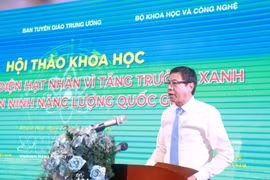
Hanoi (VNA) – Russia will facilitate Vietnamese scientists’ access to MBIR, one of the world’s leading advanced fast-neutron research reactors, to strengthen research capacity in nuclear materials, fuel and reactor technology, Dr. Tran Chi Thanh, Director of the Vietnam Atomic Energy Institute (VINATOM) under the Ministry of Science and Technology, has said.
As Vietnam develops its nuclear science and technology and prepares the necessary conditions in terms of human resources, research capacity, safety systems and technical infrastructure, participation in international research programmes and access to MBIR will enable the country to conduct experiments supporting its programme for the peaceful use of atomic energy. This will help Vietnam accumulate scientific knowledge and practical experience while gradually building its capacity to master nuclear technologies, Thanh said.
Planned research areas include testing structural materials and equipment under high-intensity irradiation, validating computational codes used in nuclear project safety assessments, and studying the characteristics and behaviour of different types of nuclear fuel and coolants.
Vietnamese scientists may also participate in research on the nuclear transmutation of minor actinides and technologies to reduce the volume and radioactivity of nuclear waste. These areas are important for improving the safety, efficiency and sustainability of nuclear technologies.
In particular, testing materials under intense neutron fluxes and evaluating nuclear fuel behaviour are essential to the research, development and refinement of advanced reactor designs, Thanh noted.
According to Russia’s State Atomic Energy Corporation Rosatom, MBIR is a multipurpose fast-neutron research reactor cooled by liquid sodium, with a thermal capacity of 150 MW. It is designed to support research into advanced nuclear technologies.
The reactor is being built in Dimitrovgrad at the Research Institute of Atomic Reactors (RIAR), part of Rosatom’s research division, under Russia’s national programme to strengthen technological leadership in nuclear and new energy technologies. It is in its final stages and soon put into operation.
Once operational, MBIR is expected to support various activities, including experimental research, radioisotope production, the development of modified materials and the testing of new equipment and technological systems./.