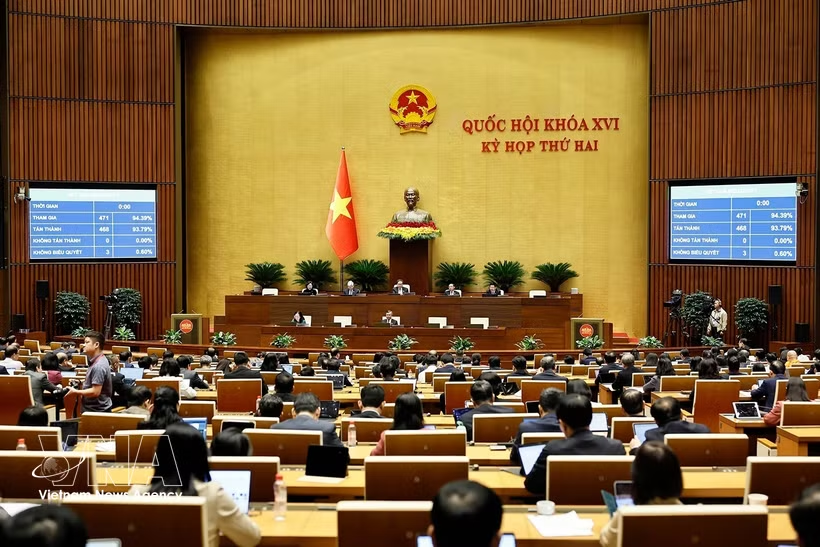
Hanoi (VNA) – Lawmakers at the 16th National Assembly (NA)’s second session on November 20 passed two laws amending and supplementing the regulations on taxation and investment.
The Law amending and supplementing several articles of the Law on Corporate Income Tax, the Law on Non-Agricultural Land Use Tax, and the Law on Personal Income Tax was passed with 475 of the 477 NA deputies present voting in favour.
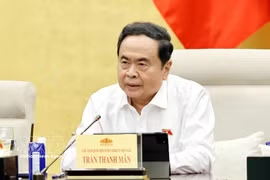
Presenting the Government’s report on the acceptance, explanation, revision, and completion of the draft law, Minister of Finance Ngo Van Tuan said corporate income tax exemptions for public educational institutions and non-profit private schools were added in line with Resolution No. 71-NQ/TW of the Political Bureau.
Based on NA deputies' voting and the NA Standing Committee's position, the Government will specify that the exemption applies only to income directly related to education and training, scientific research and educational support services.
The law also exempts businesses and individuals providing meals to educational and medical establishments from corporate and personal income taxes. According to the minister, the measure supports the development of education and healthcare in line with Resolutions No. 71-NQ/TW and No. 72-NQ/TW of the Political Bureau.
The amendments introduce several tax incentives for small- and medium-sized enterprises (SMEs), including raising the annual revenue threshold for choosing a tax calculation method from 3 billion VND to 10 billion VND and granting newly established SMEs a three-year corporate income tax exemption.
Businesses will also be allowed to deduct expenses for training, technical consultancy, product improvement and technology transfer provided by large enterprises to SMEs in their value chains. Enterprises employing large numbers of workers with disabilities or from ethnic minority groups will receive tax reductions equivalent to additional spending on these employees.
The Government will set the application period and ensure stability in tax calculation methods. To prevent abuse tax exemption policies to obtain or extend tax exemption periods, the three-year exemption will not cover businesses established through mergers, consolidations, divisions or conversions, or newly established enterprises following the dissolution of another business under the same ownership or controlling shareholders.
Regarding non-agricultural land use tax, the law exempts land used for education and training, as well as residential land within prescribed limits owned by ethnic minority households and individuals in ethnic minority and mountainous areas.
Abandoned land will be subject to a tax rate of 0.2%, while land used for purposes other than those approved will face a rate of 0.15%. The period for stabilising taxable land prices is reduced from five years to three years.
The law on personal income tax also exempts resident individuals providing meals to educational and medical establishments. Individual business operators with annual revenue of up to 10 billion VND may choose to pay tax based on income or taxable revenue.
The amended law comprises four articles and takes effect on January 1, 2027, except for certain provisions. The new revenue threshold applies from the 2027 tax year, the tax on abandoned land takes effect on July 1, 2027, and the revised land price provisions take effect on January 1, 2028.
Regarding the Law amending and supplementing certain articles of the Law on Investment, Tuan said the draft had been revised to ensure that the authority responsible for issuing investment conditions would also have the authority to decide on the relaxation.
The Government will be authorised to approve exceptional investment incentive and support packages within its jurisdiction. If a package requires changes to existing laws or resolutions, it will submit proposals to competent authorities for amendments or new regulations under simplified procedures.
The packages are intended for particularly important projects with significant socio-economic impacts, developed through negotiations with strategic investors, and requiring swift policy responses.
The revised law also clarifies special investment procedures to ensure consistency with land legislation on land allocation and leasing. It further specifies the conditions and mechanisms for applying accelerated depreciation incentives to green projects.
The Law amending and supplementing certain articles of the Law on Investment comprises three articles and will take effect on March 31, 2027, except for provisions specified in Points a, b, c and d, Clause 1, Article 2 of the law./.