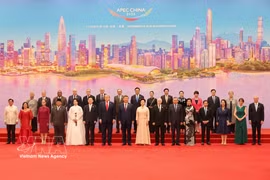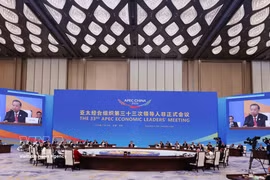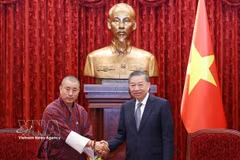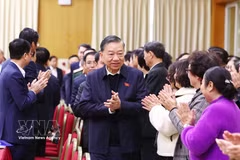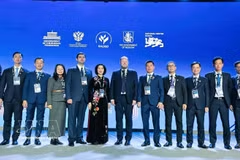
Beijing (VNA) – General Secretary of the Communist Party of Vietnam Central Committee and President To Lam's visit to China and attendance at the 33rd APEC Economic Leaders’ Meeting has delivered important outcomes in strengthening bilateral ties, promoting practical cooperation and preparing for Vietnam's APEC host year.
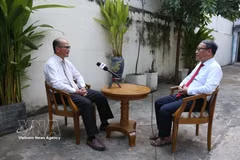
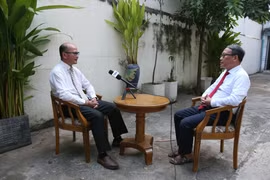
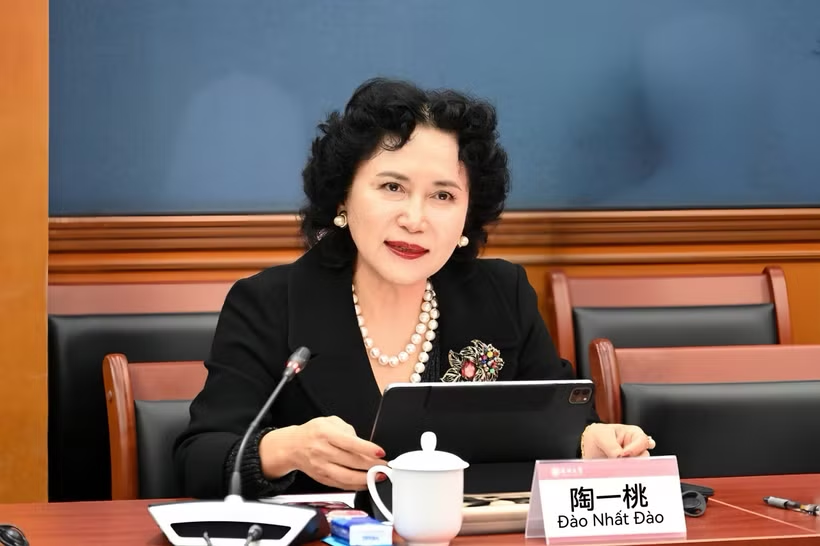
The statement was made by Professor Tao Yitao, Dean of the Belt and Road Research Institute at Shenzhen University, China, in an interview with Vietnam News Agency correspondents in China.
She described the visit as having three interconnected dimensions, namely political orientation, continuity in the APEC agenda and industrial cooperation. Its significance extended beyond the signing of cooperation documents, reflecting the strategic importance both countries attach to their bilateral relationship amid changes in regional cooperation.
Tao noted that during talks with General Secretary of the Communist Party of China Central Committee and President of China Xi Jinping, General Secretary and President Lam called for stronger strategic trust, more high-level exchanges, improved trade quality and expanded cooperation in infrastructure, energy and education.
The two leaders also discussed their countries' responsibilities as consecutive APEC hosts in 2026 and 2027, demonstrating the close link between bilateral relations and their shared commitment to regional cooperation and development.
Commenting on the Vietnamese leader’s address at the APEC CEO Summit, the professor said that the three priorities he proposed, namely building an open and inclusive trade and investment environment, developing new growth drivers, and placing people and businesses at the centre, reflect a strategic vision for addressing global challenges. In particular, she highlighted the message that APEC should serve as an open and constructive channel for strategic dialogue, acting as a bridge to help parties to resolve differences, ease tensions, and seek practical solutions amid rising protectionism.
Tao said the visit also opened up new opportunities for substantive cooperation between the two countries in science and technology. In Shenzhen, General Secretary and President To Lam attended the Vietnam–Guangdong-Hong Kong-Macao Greater Bay Area Forum on Technological Connectivity and Innovation, where he expressed his support for investments by Chinese high-tech companies in Vietnam, particularly in the fields of artificial intelligence, semiconductors, robotics, and autonomous systems.
According to Tao, bilateral cooperation could focus on three areas, namely coordinating industrial and supply chains in sectors such as electronics, supporting industries, new energy equipment, and logistics; connecting technology with Vietnam’s development needs, such as green energy, sustainable development for coastal and island areas, digital commerce, smart cities, natural disaster prevention, and agricultural and aquatic product processing; and intensifying human resources training and establishing joint laboratories and research centres.
To effectively harness this potential, Tao stressed that both sides need to resolve differences regarding standards, certifications, and intellectual property, while simultaneously strengthening Vietnam’s capacity to assimilate technologies and ensuring its technological autonomy.
Regarding APEC 2027, the professor praised Vietnam’s strategic direction, as reflected in the theme “Creating a New Era of Resilience, Innovation and Shared Prosperity," along with three priorities of improving economic productivity, promoting regional trade and investment, and strengthening economic resilience while improving people's quality of life. These demonstrate that Vietnam is not only building on the achievements of APEC 2026 but also incorporating its own development priorities and strategic orientations into the 2027 agenda.
To make its APEC 2027 chairmanship, Tao suggested that Vietnam should leverage its strengths in the maritime economy, sustainable development and regional connectivity. This could include promoting initiatives in areas such as the green economy, marine ecosystem protection, sustainable tourism, helping small and medium-sized enterprises (SMEs) integrate into value chains, and developing logistics and multimodal transport. In particular, Vietnam should focus on developing infrastructure, human resources, business connectivity mechanisms and local brands, rather than concentrating excessive resources on reception activities and event organisation.
According to the professor, China and Vietnam successively hosting APEC provides an opportunity to ensure continuity in regional cooperation. While China’s APEC Year 2026 highlights its achievements in reform and opening-up and innovation, Vietnam has an opportunity in 2027 to draw on its strengths in the maritime economy, sustainable development and regional connectivity.
Building on past achievements, maintaining networks of cooperation and forging its own distinctive identity will be key to Vietnam’s contribution to the process of building an Asia-Pacific community./.
VNA