Hoa Lac 2 becomes first Asia Pacific AI data centre meeting Uptime Tier III standards

Viettel Networks will invest capital into hyperscale data centre clusters across all three regions of Vietnam, targeting the most advanced technologies for the national programme towards digital transformation.

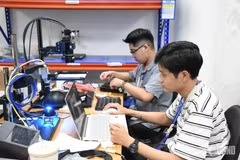
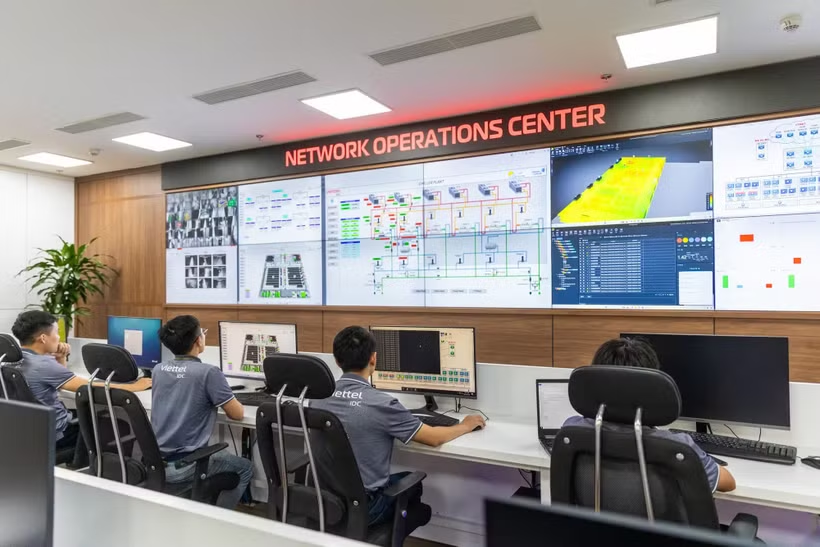
At the Viettel IDC Hoa Lac network operations centre (Photo: VietnamPlus)

Hanoi (VNA) – The Viettel Military Industry and Telecoms Group (Viettel) said on June 5 that its Hoa Lac 2 Data Centre is the first in Asia-Pacific to deploy Nvidia H200 GPU supercomputing and secure Uptime Institute’s TCCF Tier III certification, a global benchmark for safety, continuity and reliability.

Hoang Binh Son, Deputy General Director of Viettel Networks, which runs the facility, said in-house operations ensure the company delivers modern, secure digital infrastructure to citizens and businesses. Viettel Networks will invest capital into hyperscale data centre clusters across all three regions of Vietnam, targeting the most advanced technologies for the national programme towards digital transformation.

Patrick Chan, Uptime Institute’s Asia-Pacific Director, called the certification a strategic milestone, making Viettel the first telecom operator in Vietnam and the region to own a globally recognised AI data centre equipped with next-generation GPU servers, primed to operate as an “AI factory”.

That opens the door for firms to tap advanced AI computing power without heavy hardware investment, letting them build AI models tailored to their own conditions and needs.

Hoa Lac 2 stands out as the entire certification assessment run on live Nvidia H200 GPU systems. While most data centres rely on simulated workloads to test infrastructure capacity, Viettel put actual AI server clusters through the wringer, proving the facility can handle conditions that mirror real-world deployment.

Unlike conventional data centres built for storage and business apps, Hoa Lac 2 is purpose-designed for AI high-performance computing. It functions like an industrial assembly line where raw data goes in, yielding AI via advanced machine learning models.

The facility is Vietnam’s largest Tier III-compliant data centre, with 2,400 server racks serving AI, cloud computing and big data processing.

It houses more than 100 server clusters powered by Nvidia H200 GPUs and an Nvidia DGX B200 supercomputer that churns out 1.5 quintillion calculations per second, matching the combined muscle of thousands of standard computers.

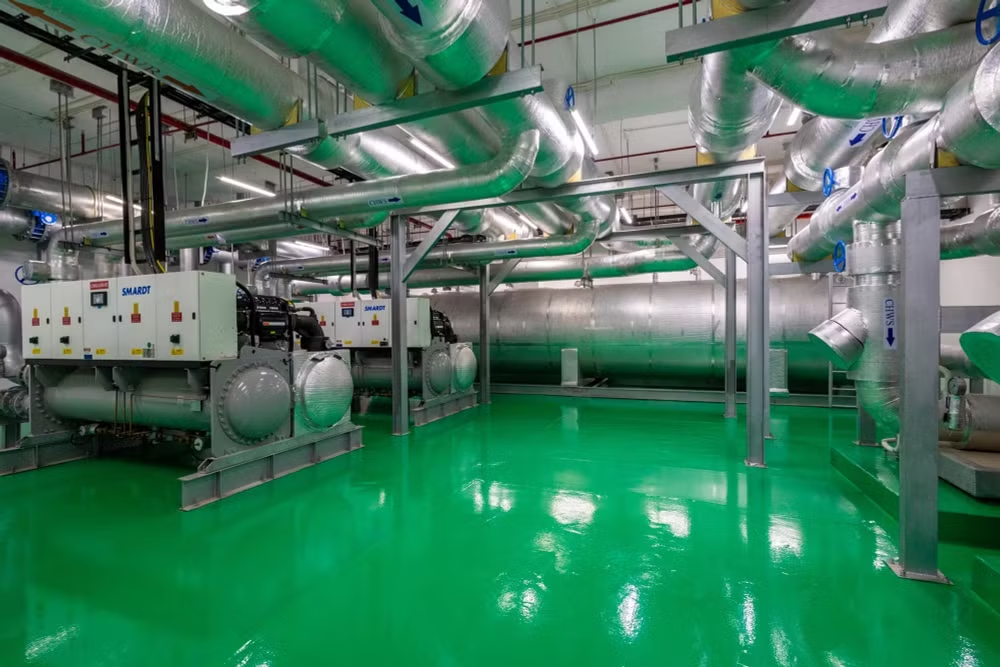
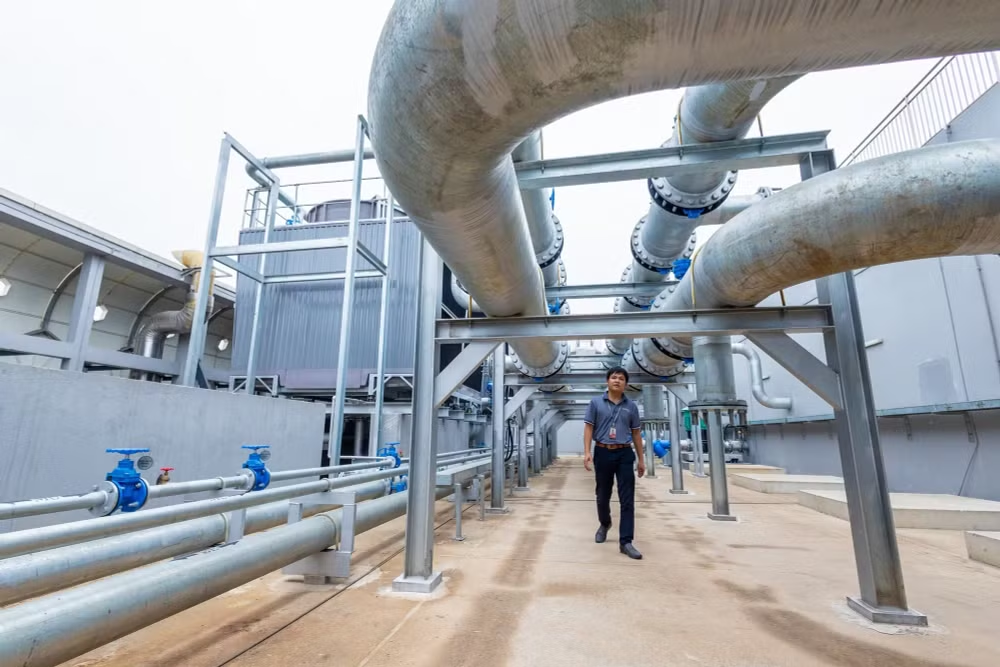
To keep servers running nonstop at extreme capacity, Hoa Lac 2 uses a 5,000-tonne cooling system, the biggest in Vietnam, with dual redundancy to guarantee uninterrupted operation.

Notably, Viettel’s own engineers handled the entire certification process, from design and technical documentation through a 120-day operational assessment that included five straight days and nights of testing, without hiring the foreign consultants many operators lean on.

Viettel is also the first operator in Asia-Pacific to test with real GPU servers rather than simulated hardware. Despite heat output three to four times normal, the cooling system held temperatures steady around 27°C in every scenario, including power outages and maintenance, underscoring exceptional reliability.
1-1932.jpg
2a.jpg
Chiller, piping systems and cooling towers operated by Viettel IDC Hoa Lac (Photo: VietnamPlus)

The entire Hoa Lac 2 infrastructure forms the backbone of Viettel Cloud, a cloud computing service developed and fully controlled in-house with no dependence on any foreign platform.

Viettel Cloud now runs 14 data centres nationwide with more than 11,500 server racks and 81,000 sq.m of floor space, supported by 500 engineers and technology experts. Viettel has been elevated to Platinum membership at the OpenInfra Foundation and holds one of the eight top seats on the foundation’s board of directors, the leading international body for open-source cloud infrastructure.

The Tier III certification not only advances Viettel’s digital infrastructure and AI push but also delivers concrete evidence of progress on the Politburo’s Resolution 57-NQ/TW, which targets breakthroughs in science, technology, innovation and national digital transformation./.
VNA

See more

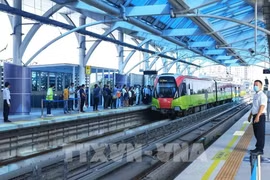
Strategic “Make in Vietnam” products: Businesses at the core

Strategic “Make in Vietnam” products: Businesses at the core

The list of six priority strategic technology products set out in the Prime Minister's Decision No. 2815/QD-TTg demonstrates an important shift in policy-making thinking, with businesses playing the central role in the innovation ecosystem and serving as the core element in the country’s goal of double-digit growth in the new era.

Vietnamese Deputy Minister of Science and Technology Hoang Minh attends the 2026 China–ASEAN Ministerial Roundtable on Artificial Intelligence in Nanning, China, on September 17. (Photo: VNA)

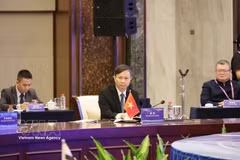
Vietnam seeks to build safe AI future with China, ASEAN

Deputy Minister of Science and Technology Hoang Minh said a safe AI future must be built on each country's governance capacity and trust among partners. Vietnam, therefore, wishes to work with China and ASEAN member states to contribute to such a future for the benefit of the people and the prosperity of the region.

The Vietnamese team at the finals of Global HackAtom 2026 in Russia from September 11–17. (Photo: published by VNA)

Vietnamese students compete in Global HackAtom 2026 finals in Russia

Participation in the international finals of Global HackAtom 2026 in Russia from September 11–17 offers Vietnamese students an opportunity to compete directly with peers from leading Russian universities with long-standing traditions in nuclear science, including Tomsk Polytechnic University and the National Research Nuclear University MEPhI.

(Photo: Organising board)

AI contest to be organised in Vietnam

Jointly organised by Sea Limited and OpenAI, the contest is expected to provide participants with hands-on experience in artificial intelligence, while also offering a platform to exchange ideas and connect with members of the country’s fast-growing AI and developer community.

The meeting between the delegation from the CPV Central Committee’s Commission for Policy and Strategy and Station F (Photo: VNA)

Vietnam, France step up cooperation in science, innovation

A delegation from the Communist Party of Vietnam (CPV) Central Committee’s Commission for Policy and Strategy paid a working visit to France from September 13-16, focusing on exchanging experience in science and technology, innovation, startup ecosystems and human resources development.

Delegates at the workshop pose for a group photo (Photo: VNA)

Digital transformation promotes sustainable development in Mekong Delta

Experts said the Mekong Delta region does not lack data, but valuable information collected by government agencies, universities, businesses, projects and communities is scattered across different locations and formats, making it difficult to access, compare and use effectively.

Soldiers from the Dien Bien provincial Military Command offer incense at the graves of fallen soldiers at A1 Martyrs’ Cemetery before exhuming remains to collect samples (Photo: VNA)

Population data, DNA technology aid efforts to identify fallen soldiers

Under the direction of the Government and the Ministry of Public Security, the ministry’s Police Department for Administrative Management of Social Order (C06) has led efforts to review and standardise information on martyrs and their relatives, collect DNA samples from relatives, and build and manage a DNA database. It also coordinates with forensic agencies to compare DNA data and identify the remains of fallen soldiers.

Students practice microcontroller programming at the Viet - Han College of Technology in Bac Ninh province (Photo: VNA)

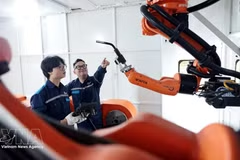
Vietnam steps up semiconductor talent training to meet market demand

Vietnam needs to step up semiconductor workforce training to meet growing market demand and enhance its capacity to participate in the global technology value chain, experts said, highlighting the importance of closely linking training with businesses, production and technological research.

Vietnam seeks to boost education and technology cooperation with France

Vietnam seeks to boost education and technology cooperation with France

Education and training, science and technology, and high-quality human resources are key areas of cooperation in Vietnam-France relations, said Politburo Member, Secretary of the Communist Party of Vietnam Central Committee, and Chairman of its Commission for Organisation Nguyen Duy Ngoc while visiting the Institut Polytechnique de Paris on September 11.

General Secretary of the Communist Party of Vietnam Central Committee and President To Lam witnesses the exchange of cooperation agreements between the two countries. (Photo: VNA)

Vietnam, France deepen cooperation in science, technology, workforce training

The University of Science and Technology of Hanoi (USTH), under the Vietnam Academy of Science and Technology (VAST), and the French Alternative Energies and Atomic Energy Commission (CEA) exchanged two cooperation agreements in Paris on September 11, in the presence of General Secretary of the Communist Party of Vietnam Central Committee and President To Lam.

A display area for unmanned aerial vehicles (UAVs) at a workshop in Da Nang city on June 12, 2026. (Photo: VNA)

Vietnam eyes UAV industry as key driver of low-altitude economy

For Vietnam, the opportunity presented by unmanned aerial vehicles (UAVs) lies not only in expanding their applications but, more importantly, in gradually building industrial capacity, mastering technologies and engaging more deeply in global value chains.

A semiconductor chip by TSMC (Photo: VCG)

Vietnam seeks deeper integration into global semiconductor value chains

Nguyen Anh Tuan, Director of the National Centre for Pilot Semiconductor Chip Manufacturing Support under the Ministry of Science and Technology, said that amid increasingly intense global technological competition, the semiconductor industry is not only a high-value-added economic sector but also a foundation for technological self-reliance, national security and economic competitiveness.

Demonstration of an autonomous electric street sweeper. (Photo: VNA)

Hanoi approves controlled pilot of two technology projects

The two projects involve an intelligent autonomous transportation system developed by Phenikaa-X JSC and a technology for producing mixed rare-earth oxides with a purity of over 95% on a semi-industrial scale developed by the Mining Technology and Construction Consultancy JSC.