📝OP-ED: Top leader urges breakthrough in following resolutions, substantive personnel assessment

Overhauling the Party’s leadership methods is an objective, inevitable and urgent requirement to elevate the Party’s governing capacity and combat strength and keep the political system effective in the new development era.

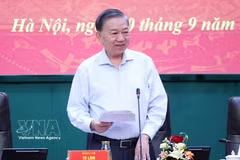
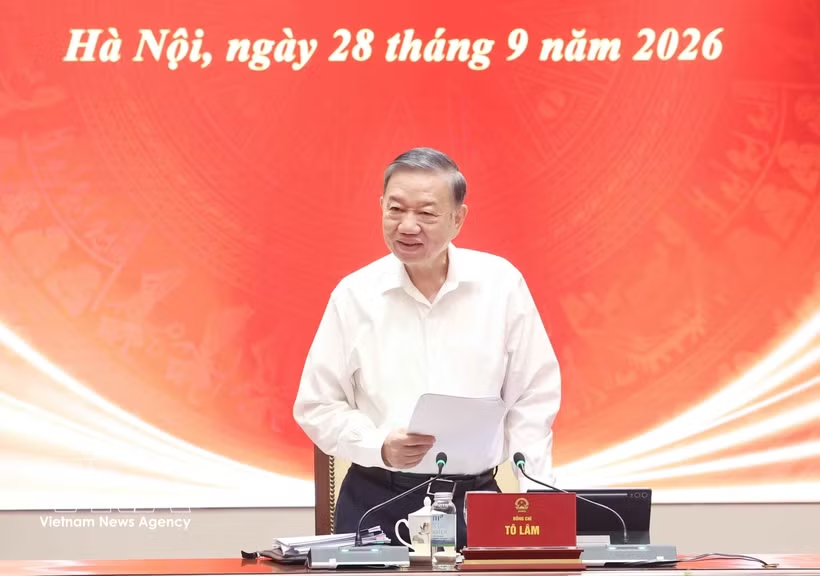
General Secretary of the CPV Central Committee and President To Lam (Photo: VNA)

Hanoi (VNA) – Almost four years have passed since the 13th Communist Party of Vietnam (CPV) Central Committee issued Resolution 28-NQ/TW on November 17, 2022 on continuing to innovate the Party's leadership and ruling methods over the political system in the new period, General Secretary of the CPV Central Committee and President To Lam told an August 20 meeting reviewing the resolution's results that reform must target key areas, make implementation the breakthrough and judge success by tangible outcomes.

The resolution sets the overall goal of creating strong and substantive changes in the Party’s leadership methods toward the political system. It seeks to strengthen the Party's governing capacity, secure comprehensive and effective leadership, and shift working methods toward a more scientific, democratic approach grounded in reality.

Overhauling the Party’s leadership methods is an objective, inevitable and urgent requirement to elevate the Party’s governing capacity and combat strength and keep the political system effective in the new development era.

In renewing the Party’s leadership methods today, it is necessary to clearly identify the priorities rather than pursue scattered and unfocused reforms. Resources and time should go to core areas and the biggest bottlenecks.

The main focus, he said, is implementation. Officials have tended to underestimate the rollout stage, and he wants Party resolutions and directives turned into reality rather than left on paper.

Even a well-designed policy delivers nothing to the public if its execution is slow or ineffective. The ability to turn decisions into action is the main determinant of whether the leadership overhaul succeeds.

The problem of "good resolutions, poor rollout" persists. Some officials stay hesitant and choose "safe" approaches, putting "not making mistakes" ahead of the quality of services delivered to citizens and businesses.

Inspection, supervision and mechanisms for dealing with inertia are also weak in many agencies and units to improve public service discipline in any substantive way.

Using tangible results as the yardstick means organisations' capacity, the administrative apparatus' effectiveness and officials' credibility should not be judged on appearances, reports or the number of resolutions issued. The review must instead weigh actual outputs, work quality, and the satisfaction and benefits delivered to the public.

The approach is meant to tackle formalism and the gap between words and action, so that every policy, resolution or task generates real value for society.

Reforms without substance carry costs. They can distort Party decision-making, waste State resources and erode public trust.

Artificially strong results can produce flattering figures that misrepresent reality and lead leaders to misjudge the situation. Policies built on a false foundation are likely to fail.

The resolution is closely tied to Resolution 26-NQ/TW, adopted by the 12th CPV Central Committee on May 19, 2018. That earlier measure focuses on building a contingent of officials at all levels, especially at the strategic level, whose qualities, capacity and credibility match their responsibilities.

If tangible results are to be the benchmark for the leadership overhaul, officials must likewise be assessed on performance reflected in concrete outputs.

One remedy for "talking more and doing less" is to tie results to officials' responsibilities under the principle of "clear roles, tasks, responsibilities and outputs." Concrete outputs and actual effectiveness will become the key criteria for assessing both organisations and individuals.

Weak measurement and verification of work results invite across-the-board ratings and leniency. They also give an inaccurate picture of the workforce's real quality.
vnanet-l.jpg
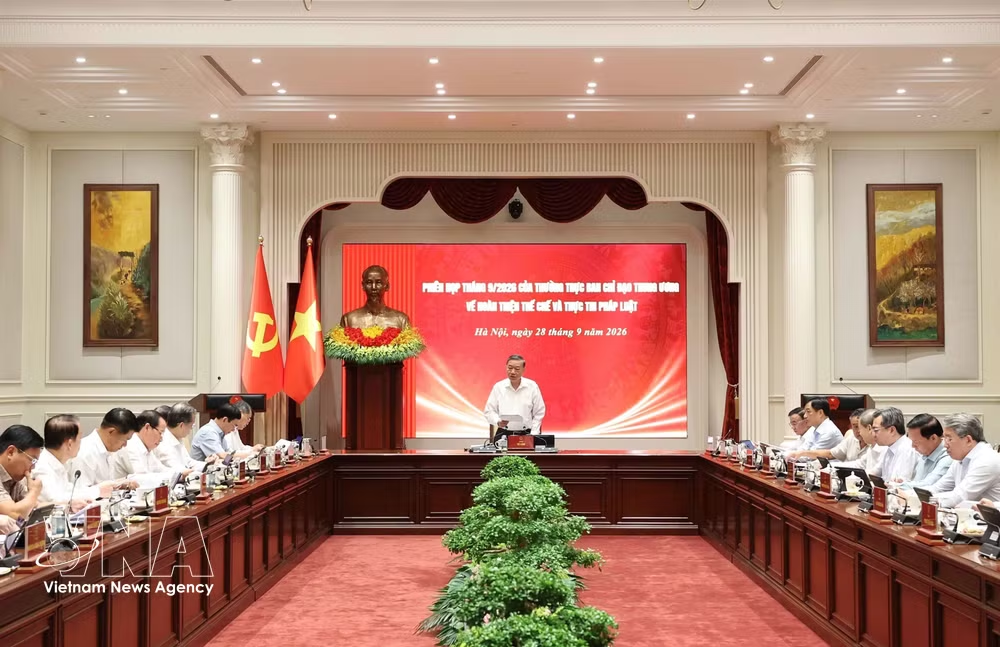
Party General Secretary and President To Lam calls on implementation to become a responsibility spanning the entire process, from policymaking to performance assessment. (Photo: VNA)

Many agencies and units have yet to set specific criteria, benchmarks or outputs that turn performance into quantitative data. Assessments rely largely on general comments, and the results are often formalistic. They are not consistently used as the core basis for personnel planning, appointment, deployment or weeding out underperformers.

Assessment based on concrete outputs should replace vague qualitative judgments with data-driven measurement. Difficult tasks can serve as a test of capacity, judged by bottlenecks cleared, complex projects completed on time, satisfaction among organisations and citizens, and the rate of cases handled effectively.

The five-year review of the Resolution 28-NQ/TW is meant to objectively assess achievements, identify shortcomings and set directions and tasks for the next phase of renewing the Party's leadership and governing methods.

General Secretary and President Lam called for a comprehensive, substantive assessment of results from the central to grassroots levels, covering the periods before and after the restructuring of the organisational apparatus.

He told the review to focus on five major bottlenecks, including the wide gap between Party policies and their enforcement; unclear boundaries in some places between political leadership and State management, and between collective authority and the responsibility of the head; decentralisation and delegation of authority that are not matched by sufficient powers, resources, data and mechanisms for power control; weak capacity for research, forecasting and early warning; and the failure to routinely use data, public feedback and task performance results in leadership and assessment.

He concluded that alongside the achievements, shortcomings need to be seriously identified and tackled. The quality and structure of the contingent of officials remain problematic, and highly capable officials and leading experts are in short supply in several strategic fields. Grassroots officials' quality is inadequate in some places. Some officials' forecasting, strategic thinking, modern governance, digital transformation and innovation skills have yet to keep pace with the new situation. Personnel assessment remains a weak link and has not brought fundamental changes, while quantifying and verifying work outputs, results and effectiveness remain limited./.
VNA

See more

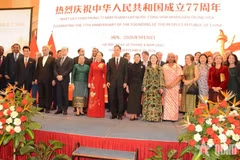
Participants pose for a group photo at the September 30 reception celebrating the 77th founding anniversary of China. (Photo: qdnd.vn)

Hanoi reception celebrates 77th founding anniversary of China

Minister of Culture, Sports and Tourism Lam Thi Phuong Thanh affirmed that the Vietnamese Party and State consistently regard the healthy development of Vietnam–China relations as a top priority and are determined to work with the Chinese Party and State to further deepen bilateral ties.

VFF leader sends congratulations to Chinese People’s Political Consultative Conference on National Day

VFF leader sends congratulations to Chinese People’s Political Consultative Conference on National Day

In the message, Bui Thi Minh Hoai, Politburo member, Secretary of the Communist Party of Vietnam (CPV) Central Committee and President of the Central Committee of the Vietnam Fatherland Front (VFF), expressed her delight that under the wise leadership of the CPC, with General Secretary and President Xi Jinping at the core, the Chinese people have achieved tremendous accomplishments in the cause of reform and opening up and the building of socialism with Chinese characteristics, with the National Committee of the CPPCC making important contributions to these achievements.

☀️ Morning digest on October 1

☀️ Morning digest on October 1

A meeting reviewing the performance of the Central Public Security Party Committee and the Ministry of Public Security, Prime Minister Le Minh Hung's reception for heads of delegations from ASEAN countries and the ASEAN Secretariat, and the 2026 Asia-Pacific Regional Dialogue on Heritage and Authenticity wrapping up are among news highlights on September 30 evening.

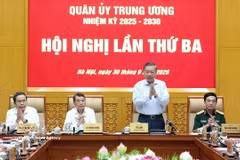
General Secretary of the Communist Party of Vietnam Central Committee and President To Lam speaks at a meeting to review the performance of the Central Public Security Party Committee and the Ministry of Public Security in the third quarter and the first nine months of 2026. (Photo: VNA)

Top leader calls for proactive approach to national security

The Central Public Security Party Committee must play a core advisory role and accelerate the implementation of resolutions, conclusions and plans already adopted, he said, stressing that the key task now was to speed up implementation and produce concrete results, said top leader To Lam.

NA Vice President Nguyen Thi Hong speaks at the meeting (Photo: VNA)

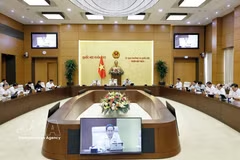
NA Standing Committee proposes priority for domestic bidding

Presenting the draft revised Bidding Law, Minister of Finance Ngo Van Tuan said the draft, comprising eight chapters and 60 articles, aims to simplify procedures, shorten project implementation time, strengthen decentralisation and delegation of authority, improve the effectiveness of State management, and handle violations and resolve petitions in bidding activities.

Illustrative Image (Photo: VNA)

People-to-people diplomacy deepens Vietnam-Germany friendship

Nguyen Anh Tuan, Chairman of the association, highlighted the important role of people-to-people diplomacy in strengthening friendship and mutual understanding between the two countries' people, particularly through Vietnamese alumni and former workers who studied and worked in Germany.

Delegates at the seminar "Canada- Vietnam: ICT and AI Cooperation" (Illustrative photo by VNA)

Vietnam-Canada strategic partnership creates new space for broader cooperation

Former Canadian member of parliament Bryon Wilfert said the state visit by General Secretary of the Communist Party of Vietnam Central Committee and President To Lam offers Canada an opportunity to elevate its relationship with one of the Indo-Pacific’s most important emerging economic and strategic partners.

An overview of the meeting (Photo: VNA)

Vietnam, Bulgaria promote substantive agricultural cooperation

The Bulgarian side highlighted the potential for cooperation with Vietnam in agricultural trade, scientific research, training and technology transfer. Bulgaria expressed readiness to share experience in sustainable agriculture, forest management and development, combating illegal, unreported and unregulated (IUU) fishing, as well as crop cultivation, livestock farming and breeding climate-resilient plant varieties.

National Assembly Vice President Nguyen Thi Thanh expresses appreciation for Switzerland’s support during important periods in Vietnam’s history at a ceremony marking the 81st anniversary of Vietnam’s National Day (Photo: VNA)

Vietnam, Switzerland seek to deepen traditional friendship, expand cooperation

Looking ahead, Vietnam wishes to work with Switzerland to further deepen bilateral relations, with traditional friendship and political trust as the foundation, economic cooperation as a pillar, and science-technology and innovation as drivers, National Assembly Vice President Nguyen Thi Thanh said, adding that the two sides should also expand cooperation in areas where Switzerland has strengths and Vietnam has needs.

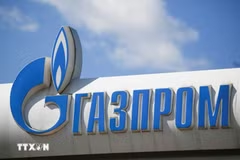
Gazprom logo at a petrol station in Moscow, Russia. (Photo: Xinhua/VNA)

Vietnam-Russia petrochemical ties hold fresh potential

He noted that trade between the Eurasian Economic Union (EAEU) and Vietnam reached 8.3 billion USD in 2025. Despite the Vietnam-EAEU Free Trade Agreement having been in force for 10 years, considerable room remains to expand economic cooperation, particularly in petrochemicals.

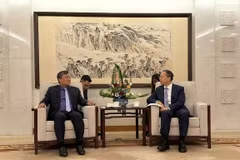
Standing Deputy Minister of Foreign Affairs Nguyen Minh Vu (L) meets with Executive Vice Minister of Foreign Affairs Ma Zhaoxu. (Photo: baoquocte.vn)

Vietnam, China propel substantive partnership

They welcomed recent gains in Vietnam-China ties, especially stronger political trust; improved cooperation mechanisms through Party, Government, parliamentary and Vietnam Fatherland Front channels; faster strategic connectivity between the two economies; expanded economic, trade and investment collaboration; and more people-to-people and locality-to-locality exchanges.