Parliamentary diplomacy strengthens Vietnam-China political trust

The trip also reaffirms Vietnam’s consistent policy of considering relations with China a strategic choice and a top priority in its foreign policy.

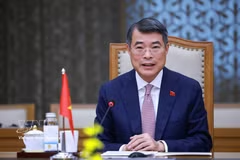
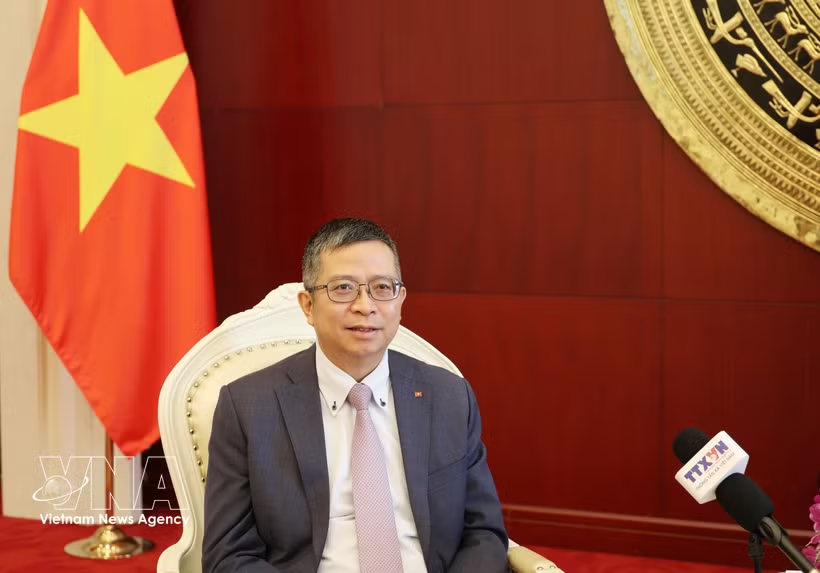
Vietnamese Ambassador to China Pham Thanh Binh. (Photo: VNA)

​Beijing (VNA) – Parliamentary diplomacy is playing an increasingly important role in strengthening political trust between Vietnam and China, creating a legal framework for bilateral cooperation and helping translate high-level agreements into concrete policies and projects, Vietnamese Ambassador to China Pham Thanh Binh has said.​

In an interview with the Vietnam News Agency (VNA)'s resident correspondent in Beijing ahead of National Assembly (NA) President Tran Thanh Man’s official visit to China from October 11-15, the Ambassador highlighted the significance of the visit and the second session of the Cooperation Committee between the NA of Vietnam and the National People’s Congress of China (NPC).​

The visit, to be made at the invitation of Chairman of the Standing Committee of the NPC Zhao Leji, will be NA President Man’s first trip to China in his current position. It will take place as Vietnam is implementing the Resolution of the 14th National Party Congress and the 16th National Assembly has begun its new term, while China enters the first year of its 15th Five-Year Plan for Economic and Social Development.​

Binh said the visit would continue the close high-level exchanges between the two Parties and countries and help implement common perceptions reached during General Secretary of the Communist Party of China Central Committee and President of China Xi Jinping’s state visit to Vietnam in April 2025 and General Secretary of the Communist Party of Vietnam (CPV) Central Committee and President To Lam’s state visit to China in April 2026.​

The trip also reaffirms Vietnam’s consistent policy of considering relations with China a strategic choice and a top priority in its foreign policy, he said.​

According to the Ambassador, the visit is expected to deepen the Comprehensive Strategic Cooperative Partnership and advance the building of a Vietnam-China community with a shared future that carries strategic significance at a higher level in the new era, guided by the “six major orientations”.​

The visit is also particularly important to cooperation between the two legislative bodies. Following the successful first session of the Cooperation Committee held in Hanoi on August 31, 2025, the second session is expected to make the mechanism more regular, with clearer programmes, priorities and areas of focus.​

Binh noted that high-level orientations needed to be followed up through appropriate legal frameworks, coordination among specialised agencies and monitoring of implementation. This is a practical contribution that the two legislatures can make to bilateral relations.​

Bilateral ties maintain positive momentum​

Assessing Vietnam-China relations since the beginning of 2026, the Ambassador said development had remained positive and comprehensive, particularly following the top Vietnamese leader’s state visit to China in April.​

Political trust has continued to be strengthened through regular high-level and other exchanges and the effective operation of cooperation mechanisms, including the Steering Committee for Vietnam-China Bilateral Cooperation and the “3+3” Ministerial Strategic Dialogue on Foreign Affairs, Defence and Public Security.​

Defence and security cooperation has also become more substantive, while coordination at multilateral mechanisms and forums has continued to increase.​

Economic and trade cooperation, investment and infrastructure connectivity have recorded strong growth. Railway connectivity has made new progress and entered a stage of substantive implementation, while the development of smart border gates and cross-border economic cooperation zones is being accelerated.​

According to the Ambassador, bilateral trade reached approximately 216.1 billion USD in the first eight months of 2026, up 35.2% year on year. The figure reflects the increasingly close and complementary links between the two economies within regional production and supply chains.​

Cooperation is also expanding into areas linked to future development, including science and technology, innovation, digital economy, green transition, clean energy and human resources development.​

The two sides are paying greater attention to connecting production and supply chains, strengthening industrial capacity and using technology safely and effectively, he said.​

Meanwhile, local-level cooperation, culture, education, tourism and people-to-people exchanges have remained vibrant. The two countries are actively implementing the Vietnam-China tourism cooperation year 2026-2027 and the “Red study tour” programmes for young people’s study and research, helping enhance mutual understanding and friendship and strengthen the social foundation of bilateral ties.​

“These results show that the common perceptions and major orientations reached by the top leaders of the two Parties and countries are increasingly being translated into concrete cooperation outcomes, bringing practical benefits to the people of both countries,” Binh stressed.​

Four priorities for parliamentary cooperation​

The Ambassador described cooperation between the Vietnamese NA and the NPC of China as an important component of overall Vietnam-China relations.​

Alongside Party-to-Party diplomacy, State diplomacy and people-to-people diplomacy, parliamentary diplomacy is increasingly contributing to political trust, creating legal frameworks for cooperation and helping turn high-level common perceptions and agreements into policies, cooperation programmes and practical benefits.​

He shared his hope that NA President Man’s visit would lead to meaningful outcomes in four key areas.​

First, it would further strengthen political trust and concretise common perceptions between the top leaders of the two Parties and countries, contributing to the development of the Comprehensive Strategic Cooperative Partnership and the building of the Vietnam–China community with a shared future that carries strategic significance at a higher level in the new period with “six major orientations”.​

Second, the visit would elevate and deepen cooperation between the two legislative bodies, particularly through the second session of the Cooperation Committee. The two sides are expected to review implementation of previously agreed areas, identify priorities for the coming period and increase exchanges among specialised agencies on legislation, supervision, decision-making on major national issues and institutional development.​

Third, the two legislatures are expected to enhance their role in creating legal frameworks and supervising the implementation of bilateral agreements and practical cooperation projects. They can also help identify and address policy and legal obstacles, particularly in infrastructure connectivity, trade and investment, science and technology, innovation, digital transformation and human resources development, on the basis of equality and mutual benefit.​

Fourth, parliamentary exchanges between deputies, friendship parliamentary groups and local-level legislative bodies will be strengthened, alongside people-to-people exchanges. The two sides will also step up coordination at regional and international inter-parliamentary forums, contributing to the effective management of differences and to peace, stability, cooperation and development in the region and the world.​

Binh expressed his confidence that, with the determination of the two countries' leaders and close coordination between the NA of Vietnam and the NPC of China, the visit would mark new progress in cooperation between the two Parties and countries and between their legislative bodies, helping to further strengthen and develop the Vietnam-China Comprehensive Strategic Cooperative Partnership./.
VNA

See more

General Secretary of the Party Central Committee and President To Lam delivers the closing remarks at the fourth meeting of the 14th Communist Party of Vietnam Central Committee on October 8, 2026. (Photo: VNA)

14th Party Central Committee wraps up fourth meeting

The decisions issued at this meeting aim to strengthen leadership and implementation capacity and rally the strength of the entire nation, with the value of the plenum ultimately reflected in the issues addressed and improvements in people’s lives.

The article by Uch Leang, Acting Director of Asian, African, and Middle East Studies of the International Relations Institute of Cambodia (IRIC) and the President of the Cambodia Alumni from Vietnam Association (CAVA) on Khmer Times (Photo: VNA)

Vietnamese PM’s visit opens new phase of cooperation between Vietnam, Cambodia

The visit comes as the two countries are actively preparing to commemorate the 60th anniversary of the establishment of diplomatic relations in 2027. It therefore provides an important opportunity for both sides to review the achievements of six decades of cooperation, assess existing challenges, and reaffirm their determination to bring bilateral relations to a new level, Uch Leang, Acting Director of Asian, African, and Middle East Studies of the International Relations Institute of Cambodia (IRIC) and the President of the Cambodia Alumni from Vietnam Association (CAVA).

PM arrives in Vientiane, beginning official visit to Laos

PM arrives in Vientiane, beginning official visit to Laos

The visit provides an opportunity for the two Parties and Governments to reaffirm the special solidarity and faithful bond between Vietnam and Laos, a close relationship forged, tested and continuously nurtured throughout history. It also demonstrates the political resolve of the senior leaders of the two Parties and Governments to further develop the Vietnam–Laos special relationship in an increasingly substantive and effective manner.

Chairwoman of the Vietnam-RoK Friendship Association in Ho Chi Minh City Tran Thi Dieu Thuy speaks at the ceremony celebrating the RoK’s National Foundation Day. (Photo: VNA)

Vietnam, RoK promote friendship, mutual understanding

Around 350,000 Vietnamese are currently living, studying and working in the RoK, while some 200,000 Koreans are residing and working in Vietnam. Together with Vietnamese-Korean multicultural families, these communities have become natural bridges connecting the two peoples.

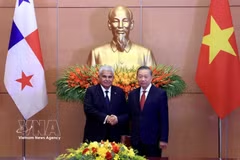
General Secretary of the Communist Party of Vietnam Central Committee and President To Lam (R) and President of Panama José Raúl Mulino pose for a photo. (Photo: VNA)

Panamanian President wraps up official visit to Vietnam

The two sides expressed their delight at the positive developments in bilateral relations in recent years, noting that there remains significant room for greater cooperation and complementarity, particularly in trade, investment and economic ties. They also held extensive discussions on strategic directions to further deepen and strengthen bilateral relations in a more substantive and practical manner.

Prime Minister Le Minh Hung and a high-ranking Vietnamese delegation leaves Hanoi on October 8 for official visits to Laos and Cambodia. (Photo: VNA)

Prime Minister Le Minh Hung departs for official visits to Laos, Cambodia

This is PM Hung’s first official trip to Laos and Cambodia, reaffirming the high importance and priority that the Party, State and Government of Vietnam attach to relations with the two neighbouring countries. It also helps further deepen the “great friendship, special solidarity, comprehensive cooperation and strategic cohesion” between Vietnam and Laos and the “good neighbourliness, traditional friendship, comprehensive cooperation and long-term sustainability” between Vietnam and Cambodia.

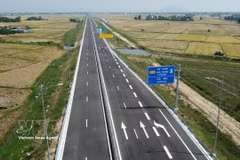
The North-South Expressway (Eastern section) project in Dak Lak province has been completed (Photo: VNA)

Deputy PM orders removal of bottlenecks in key projects

Key projects in the industry and trade and construction sectors play a particularly important role in driving growth, boosting production, strengthening infrastructure capacity, ensuring energy security, enhancing the competitiveness of the economy and creating new momentum for development in the coming period.

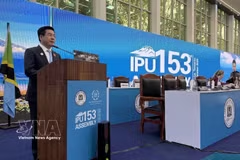
National Assembly Vice President Nguyen Hong Dien addresses the high-level General Debate of the 153rd Assembly of the Inter-Parliamentary Union (IPU-153) in Arusha, Tanzania, on October 7 (Photo: VNA)

NA Vice President proposes priorities for inter-parliamentary cooperation

Vietnam is determined to undertake strong institutional reforms to create a development-enabling environment, with science and technology, innovation, digital transformation, green transition and the circular economy serving as key drivers. The Vietnamese NA is also stepping up lawmaking, supreme oversight and making decisions on major national issues.

Prime Minister Le Minh Hung (Photo: VNA)

PM Le Minh Hung’s Laos visit to help deepen bilateral relations

The two countries established diplomatic relations on September 5, 1962. On July 18, 1977, they signed the Treaty of Friendship and Cooperation, providing an important political and legal foundation for strengthening bilateral ties and supporting each country’s cause of national construction and defence.

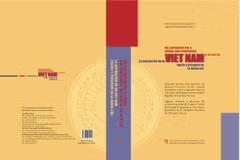
The cover of the book “The Aspiration for a Strong and Prosperous Viet Nam in the New Era,” in Mexico on October 8, 2026. (Photo: VNA Publishing House)

VNA cooperates with Mexican Labour Party to publish book on top leader's articles and addresses

The bilingual English-Spanish publication comprises 46 selected articles and speeches drawn from the political commentaries and addresses by General Secretary of the Central Committee of the Communist Party of Viet Nam (CPV) and President of the Socialist Republic of Viet Nam To Lam since August 2024, reflecting the mindset, vision and strategic decisions of the CPV to steer the country firmly into the new era.

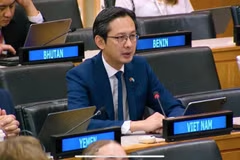
Ambassador Do Hung Viet, Permanent Representative of Vietnam to the United Nations, speaks at the general debate of the UN General Assembly’s Second Committee (Economic and Financial Committee) in New York. (Photo: VNA)

Vietnam calls for stronger int'l cooperation to drive sustainable development

Vietnam calls for stronger global partnerships tailored to the needs and conditions of countries at different levels of development, including fair access to new and emerging technologies. Such cooperation will help developing countries acquire knowledge, skills and technologies needed for innovation and competitiveness.

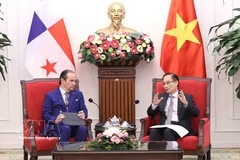
Vietnamese Minister of Foreign Affairs Le Hoai Trung (R) meets with his Panamanian counterpart Javier Eduardo Martínez-Acha Vásquez in Hanoi on October 7. (Photo: VNA)

Vietnamese, Panamanian foreign ministers discuss bilateral cooperation

The two sides encouraged businesses from both countries to expand investment and business links, making use of Panama’s strengths as a maritime transit hub and a regional centre for aviation, logistics and finance, as well as Vietnam’s strengths in manufacturing, export, economy and digital services.

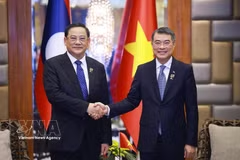
On the sidelines of the 48th ASEAN Summit in Cebu, Philippines, on the afternoon of May 8, 2026, Prime Minister Le Minh Hung met with the then-Prime Minister of Laos, Sonexay Siphandone. (Photo: VNA)

Vietnam-Laos ties move from ‘special solidarity’ to ‘strategic cohesion’

As Vietnam and Laos enter a new development period, their relationship has been elevated to a new level under the framework of “great friendship, special solidarity, comprehensive cooperation and strategic cohesion.” The addition of “strategic cohesion” reflects not only the long-standing foundation of bilateral ties but also a shared vision, closely linked interests and a common path for the two nations to advance together over the long term.

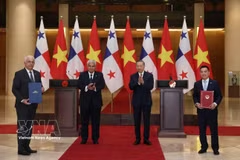
Party General Secretary and President To Lam (second from right) and President of Panama José Raúl Mulino Quintero (second from left) witness the exchange of cooperation documents between the two countries. (Photo: VNA)

Vietnam, Panama issue Joint Statement

Vietnam's Party General Secretary and President To Lam and Panamanian President José Raúl Mulino Quintero agreed to intensify high-level dialogue to provide orientations for the development of Vietnam-Panama relations through bilateral visits and meetings between high-ranking leaders of the two States, Governments, and National Assemblies, as well as ministries and sectors of the two countries.