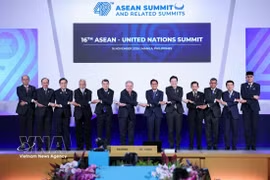
Manila (VNA) – Prime Minister Le Minh Hung and the Vietnamese delegation left Manila for Hanoi on the evening of November 17, successfully concluding their working trip to the Philippines, where they attended the 49th ASEAN Summit and related summits at the invitation of Ferdinand Romualdez Marcos Jr., President of the Philippines - ASEAN Chair in 2026.
During the four-day trip, PM Hung attended a series of multilateral and bilateral activities, including ASEAN meetings, and summits between ASEAN and dialogue partners, engagements with leaders of ASEAN member states and other countries and international organisations.
Addressing the ASEAN Business and Investment Summit (ABIS) 2026, the PM proposed developing infrastructure for ASEAN's future economy, focusing on four priorities: cross-border transport and logistics, energy, digital connectivity, and institutional and people-to-people links.
He also outlined four areas for action: formulating an ASEAN infrastructure priority list through 2040; enhancing coordination on cross-border projects; developing an ecosystem for project preparation and regional financing mobilisation; and engaging the private sector as a substantive partner.
At the plenary session of the 49th ASEAN Summit, PM Hung proposed three strategic orientations for the bloc: maintaining a peaceful and stable environment for development; promoting dynamic, innovative and resilient growth; and upholding ASEAN's identity to build a cohesive and sustainable Community.
At the summit's retreat session, PM Hung put forward three proposals to safeguard regional peace, security and development: strengthening trust and addressing differences through dialogue; proactively preventing and managing crises and responding to common challenges; and taking a more active role in shaping cooperation with partners, moving beyond maintaining ASEAN centrality to further reinforcing it.
At the 15th ASEAN Leaders' Interface with Representatives of the ASEAN Inter-Parliamentary Assembly (AIPA), he called for closer coordination between governments and parliaments and greater reflection of people's aspirations in the ASEAN Community-building process.
He proposed three priorities for ASEAN-AIPA cooperation: early consultation and effective implementation; strengthening solidarity and trust; and focusing on initiatives that bring tangible benefits to people. He also urged ASEAN member parliaments to promptly consider ratifying the United Nations Convention against Cybercrime, known as the Hanoi Convention, to establish a legal foundation for more effective international cooperation.
At summits with China, the United Nations, Australia, the Republic of Korea, Japan, India and the US, as well as the ASEAN Plus Three Summit, the Mekong-Republic of Korea Summit, the Mekong-Japan Summit, which Vietnam co-chaired, the fourth Asia Zero-Emission Community (AZEC) Leaders' Meeting and the East Asia Summit (EAS), PM Hung stressed the need to accelerate economic integration and connectivity, strengthen self-reliance and collective resilience, and build a secure, inclusive and future-ready digital economy. He also called for science and technology, innovation and digital transformation to become new pillars of regional cooperation.
On the sidelines, PM Hung held bilateral meetings with leaders of Brazil, Canada, Australia and Thailand, and exchanges with leaders of Laos, the Philippines, Singapore and Cambodia. He also met with the Managing Director of the International Monetary Fund (IMF) and other international partners. The engagements helped identify new cooperation directions in line with the parties' development priorities and emerging opportunities./.