Vietnam climbs seven spots to 52nd in WEF tourism index

Within Southeast Asia, Vietnam ranked fifth, trailing Singapore (13th), Indonesia (23rd), Malaysia (26th) and Thailand (38th). Its 6.1% score gain, however, outpaced all four.

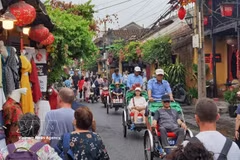
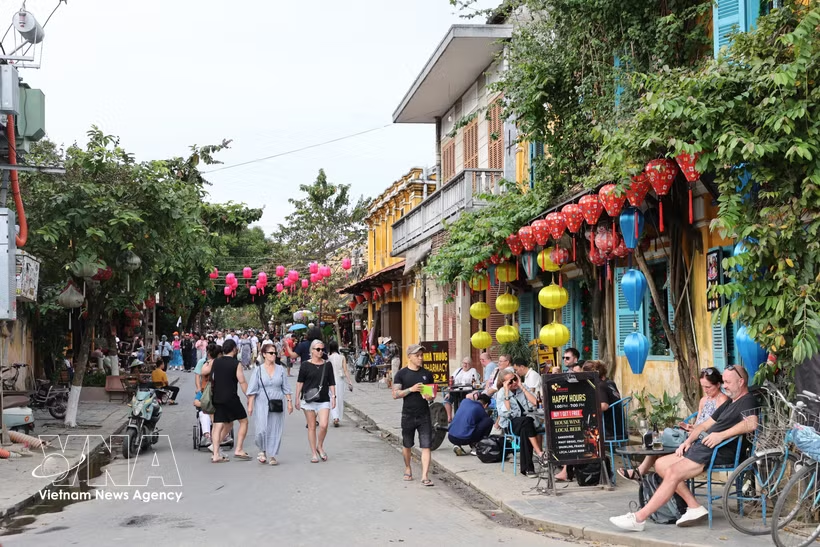
Foreigners tour Hoi An Ancient Town in Da Nang city. (Photo: VNA)

Hanoi (VNA) – Vietnam rose seven places from 2024 and 11 from 2019 to rank 52nd among 110 economies in the World Economic Forum (WEF)'s 2026 Travel & Tourism Development Index (TTDI), the Vietnam National Authority of Tourism (VNAT) said.

Its score rose 6.1% from 2024 to 4.15. The index gauges the factors and policies that underpin a sustainable, resilient tourism sector. It does not track performance metrics such as visitor numbers, spending or revenue, but measures the conditions that let a destination attract visitors, deliver services and sustain activity over the long term.

The TTDI is built on five dimensions, 17 pillars and 102 indicators. The dimensions are enabling environment, tourism policy and favourable conditions, infrastructure and services, travel resources, and tourism sustainability.

Indicators roll up into scores for each of the 17 pillars, and the overall TTDI score is the arithmetic mean of those pillar scores. The five dimensions are used mainly to organise and present results.

Indicators are standardised on a scale of 1 to 7, allowing economies to be compared on their level of development and their capacity to create a favourable environment for tourism.

Within Southeast Asia, Vietnam ranked fifth, trailing Singapore (13th), Indonesia (23rd), Malaysia (26th) and Thailand (38th). Its 6.1% score gain, however, outpaced all four.

Tourism climate improves across key pillars

Notably, seven Vietnamese pillars placed among the world's top performers (1st to 35th), up from four in 2024. Price competitiveness, at seventh, and safety and security, at ninth, ranked highest.
vnanet-e.jpg
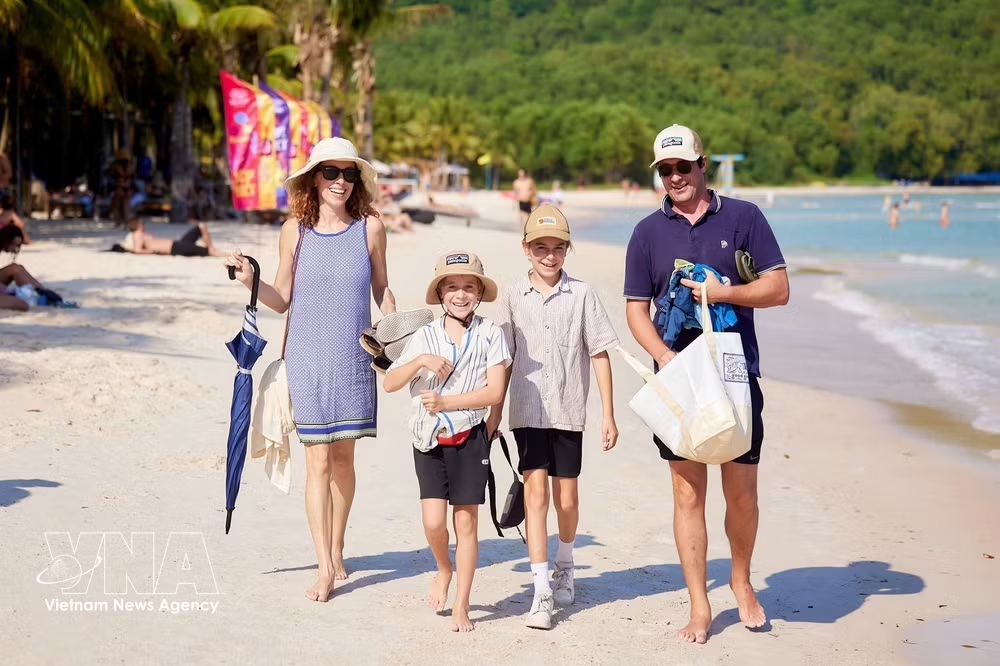
Foreign visitors stroll along Khem Beach in Phu Quoc special zone, An Giang province. (Photo: VNA)

VNAT said price competitiveness gained eight places and safety and security 18, reflecting WEF's favourable view of Vietnam's political – social stability and security amid global volatility. These factors have been central to Vietnam's appeal to foreign visitors in recent years.

Next came cultural resources (21st), natural resources (22nd), travel demand sustainability (27th), non-leisure resources (30th) and air transport infrastructure (34th).

Against the previous rankings, air transport infrastructure gained nine places, ground and port infrastructure 10, cultural resources six and natural resources four. Environmental sustainability jumped 18 places. Travel demand sustainability made the biggest leap, climbing 24 places to 27th.

Six pillars landed in the upper-middle tier (36th to 70th), including ground and port infrastructure (43rd), workforce and labour market (50th), ICT readiness (58th), business environment (63rd), tourism openness (67th) and health and hygiene (68th).

In all, 13 of Vietnam's 17 pillars ranked from upper-middle to world-leading. The other four fell in the lower-middle and low tiers (71st to 110th), including tourism infrastructure and services, environmental sustainability, travel prioritisation, and the socio-economic impact of tourism./.​

VNA

See more

Visitors tour Hoi An Ancient Town in Da Nang city. (Photo: VNA)

Vietnam’s tourism targets 12% of GDP by 2030

Resolution 26-NQ/TW targets a direct GDP contribution of 10–12% by 2030, 45–50 million foreign arrivals, 160 million domestic visitors, and total revenue of 80–90 billion USD.

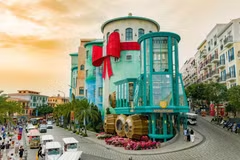
Located on Apollo Square in the heart of Sunset Town, Phu Quoc, Apollo Cafe is a distinctive venue designed by renowned architect Bill Bensley.

Coffee beneath an “upside-down” town: A surreal stop in Phu Quoc

With an entire town recreated on its ceiling, sweeping sunset views and a vantage point for watching fireworks after dark, Apollo Cafe in Phu Quoc offers more than a photogenic backdrop. Designed by Bill Bensley, the venue shows how a café can become an experience travellers deliberately build into their itinerary.

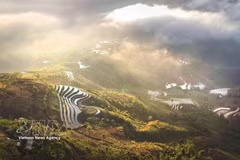
Terraced fields shimmering with water create a picturesque scene in Lang Sang Village, Ta Xua Commune. (Photo: VNA)

Ta Xua named Asia’s leading emerging tourism destination 2026

In recent years, Ta Xua, dubbed "the paradise of clouds", has emerged as one of the mountainous destinations attracting strong interest from young travellers, particularly for its spectacular sea of clouds stretching across the mountains in the northwestern region.

AirAsia highlights Kem Beach as a family-friendly destination, where children can play on the sand while parents enjoy a little more time relaxing by the sea. (Photo: VNA)

AirAsia recommends Phu Quoc as ideal destination for family travel

A familiar low-cost airline among Southeast Asian travellers, AirAsia describes Phu Quoc in its blog guide to travelling with young children as a destination that feels almost tailor-made for families, with beaches for relaxation, leisure attractions and a wide range of activities to engage children of different ages.

Ho Chi Minh City Central Post Office remains a popular attraction for domestic and international tourists. (Photo: VNA)

Ho Chi Minh City wins three top Asian tourism awards in 2026

The 2026 honours add to the city’s impressive streak at international tourism awards. In the 2025 WTA, the southern metropolis took home four titles, including business travel and festival and event destination awards, which it had won for four years from 2022 to 2025.

Phu Quoc is building its capacity to host MICE tourism, with international resorts, event venues, world-class shows and an expanding flight network. (Photo: Sunset Town)

Why does Travel + Leisure call Phu Quoc Asia’s next MICE hotspot?

According to the magazine, Phu Quoc was once known primarily for its beaches and relaxed holiday atmosphere. Over the past two years, alongside that appeal, the island has gradually developed its capacity to serve the MICE market, with international resorts, event venues, world-class shows and an expanding flight network.

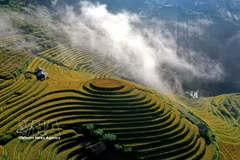
Every year, from September to October, terraced rice fields in Mu Cang Chai and Pung Luong communes, Lao Cai province, turn a golden yellow, creating a spectacular landscape across the northwestern mountains. (Photo: VNA)

Indigenous culture becomes tourism asset in northern highlands

With growing recognition of indigenous knowledge, customs and cultural values as unique assets, ethnic communities in the northern mountainous region are shifting from simply providing tourism services to becoming creators and owners of tourism products, confidently telling their own cultural stories

Tourists watch the sunset from the Kiss Bridge in Phu Quoc special zone, An Giang province. (Photo published by VNA)

An Giang's tourism sector grows, prepares for APEC 2027

Phu Quoc remains the biggest contributor to An Giang's international arrivals and tourism revenue. The special zone welcomed more than 1.92 million foreign visitors during the nine-month period, accounting for over 99% of all international arrivals in the province.

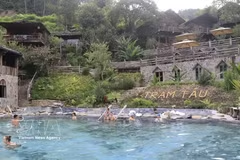
Wellness tourism is gradually becoming a high-value-added segment, extending international visitors' length of stay in Vietnam. (Photo: VNA)

Vietnam leans on wellness tourism to unlock higher-value segment by 2030

Vietnam has the abundant natural resources, including beaches, forests, mineral springs, mineral mud and a wide range of medicinal plants, backed by a long-lasting traditional medicine and the cultural identity of its ethnic communities. Together, they form the base for wellness tourism products that are both competitive and distinctly Vietnamese.

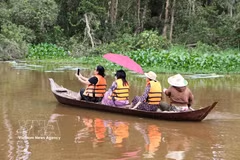
Visitors travel by boat to admire the cajuput forest landscape during the flood season at the Tram Chim tourism site in Dong Thap province. (Photo: VNA)

Dong Thap parlays flood season into tourism opportunity

At the Tram Chim tourism site, part of Tram Chim National Park in Tram Chim commune, visitors can try fishing with nets and hooks, setting traps and dismantling brush piles to catch field rats from August to November, the peak flood season.

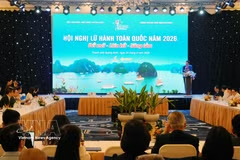
The national travel conference in Quang Ninh city on September 24, 2026. (Photo: VNA)

Vietnam’s travel sector shifts focus towards quality, value chains

The conference served as an important forum to assess changes and bottlenecks facing the tourism sector, while identifying breakthrough solutions to realise the goal of making tourism a key economic sector, as set out in Politburo Resolution No. 26-NQ/TW and Government Resolution No. 263/NQ-CP.

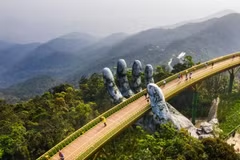
The iconic Golden Bridge at Sun World Ba Na Hills was chosen by Lonely Planet as the feature image when naming Da Nang among the top destinations for 2027.

Lonely Planet names Da Nang among the Best in Travel 2027, choosing Golden Bridge as the feature image

The city’s allure, as suggested by Lonely Planet, lies in its ability to combine diverse experiences in a single trip: relaxing by My Khe Beach, exploring nature, savouring local cuisine, and dedicating time to cultural and entertainment destinations. This versatility enables Da Nang to attract both leisure travelers seeking a relaxed getaway and those looking for an activity-packed itinerary.