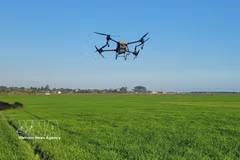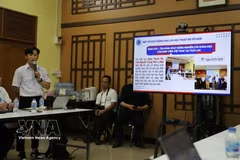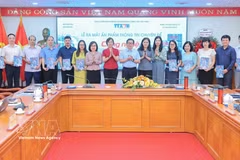
Hanoi (VNA) – From the sturdy landline telephones of the 1990s to semiconductors and long-range unmanned aerial vehicles (UAV) today, CT Group – one of Vietnam's largest technology and innovation conglomerates – has pursued a three-decade journey driven by an ambition to master homegrown technology.
In a conversation with VietnamPlus, Tran Kim Chung, Chairman of CT Group, reflected on the aspirations surrounding Vietnam’s entry into a new era anchored by a powerful UAV industry. Few people realise that, he said, as early as 1995, when mobile phones were virtually nonexistent in Vietnam and the domestic technology sector remained in its infancy, CT Group had already begun assembling desk telephones known for their durability and clear sound quality.
After more than 30 years guided by a spirit of national self-reliance, the group now claims to command advanced technologies across twelve high-tech fields, including unmanned aerial vehicles, the low-altitude economy, a fifteen-layer national digital twin system, robotic housing, biotechnology, innovation centres, carbon credits, semiconductor chips, space technology, autonomous vehicles, artificial intelligence and digital currency.
According to Chung, mastering core technologies alone is insufficient. Vietnamese enterprises must also cultivate a strong capacity for innovation to sustain continuous development of superior new technologies. “Falling behind in research and development by even a single year can mean being pushed out of the race,” he observed.
He argued that the world is changing at unprecedented speed, with once-stable global orders increasingly disrupted. In the era of the Fourth Industrial Revolution, no nation can claim genuine independence if it remains technologically dependent on others.
In sectors such as semiconductors and UAVs, the business leader suggested that Vietnam should prioritise hiring international experts, including highly skilled overseas Vietnamese, to train and develop domestic talents within Vietnamese corporations. The next step is to accelerate the rate at which Vietnamese inventors produce patents and breakthroughs, he said.
The Global Innovation Index (GII) also matters. Countries seeking technological autonomy from a late starting point must achieve innovation indices surpassing those of more advanced nations, he added.
Chung described 2026 as a potential breakthrough year, with numerous products emerging from the intellect, determination and sustained efforts of Vietnamese scientists and engineers. CT Group is entering the year with a new “Go Global” strategy, aiming for Vietnamese-made technologies to serve not only domestic needs but also demanding international markets such as Europe, the US, the Republic of Korea and Japan. Of the group’s projected revenue of 57 trillion VND (2.16 billion USD) this year, some 37 trillion VND, or 64%, is expected to come from science, technology and advanced industries.
He also noted that the company has undertaken key commitments to the Government, including working with other corporations to position Vietnam as the leading UAV power in the Association of Southeast Asian Nations (ASEAN) and to build a low-altitude economy that ranks among the region’s most advanced.
Addressing younger generations, Chung described the present moment as a golden opportunity. “You are standing at a turning point between the Third and Fourth Industrial Revolutions,” he said. “At such a moment, you may achieve greatness, or become dependent on new technologies.”/.