Removing bottlenecks helps Vietnam harness global supply chains

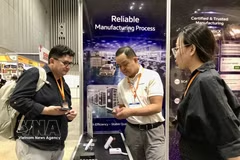
VASI Vice Chairman Pham Minh Thang said Vietnamese firms seeking to integrate into global value chains must build equipment and management systems aligned with global technological advancements.

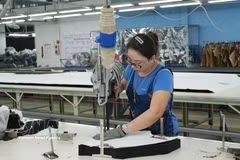
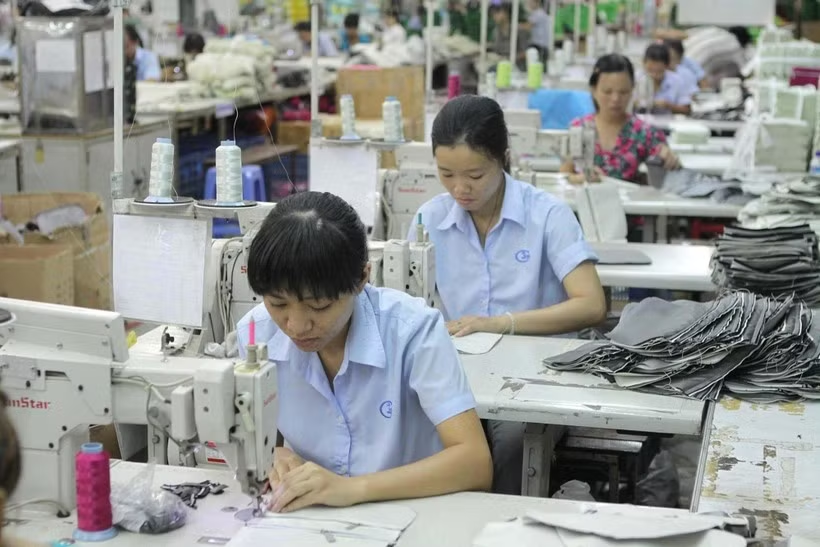
For decades, Vietnam's supporting industry enterprises have been largely confined to low-value outsourcing segments. (Photo: VietnamPlus)

Hanoi (VNA) – Bold investment in core technologies, the adoption of new financial instruments, and workforce “AI integration” strategies are emerging as breakthrough solutions, helping domestic firms overcome long-standing bottlenecks and confidently enter higher-value global markets.

As the world enters the 2025–2030 period, digital and green transformation have become essential to meet new technical barriers such as CBAM and stricter ESG standards in major markets.

According to the Vietnam Association for Supporting Industries (VASI), many enterprises still attempt to cut costs by relying on decades-old machinery. This patchwork approach has unintentionally created a capability gap when facing orders that demand high precision and strict sustainability standards.

VASI Vice Chairman Pham Minh Thang said Vietnamese firms seeking to integrate into global value chains must build equipment and management systems aligned with global technological advancements.

However, technology alone is not enough, human capital remains the decisive factor in transformation.

This shift also requires businesses to redefine their positioning. Experts stress that over the next one to three years, companies must transition from a “supplier” mindset to that of a strategic “partner.”
xv72199.jpg
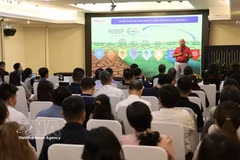
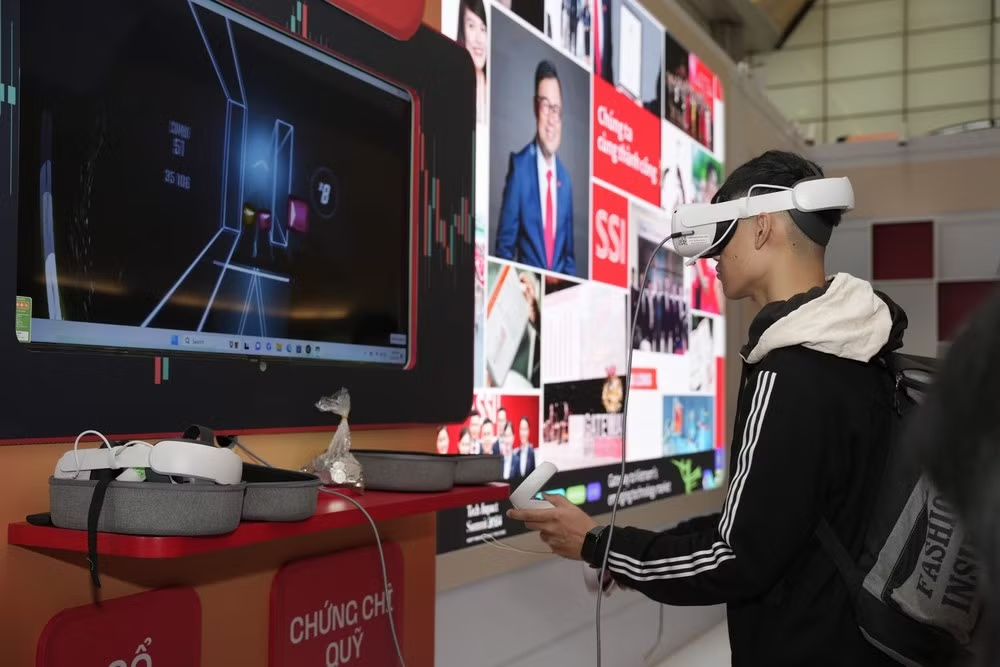
When every employee possesses a digital mindset and the ability to harness AI, businesses can build a leaner and more intelligent operating system. (Photo: VietnamPlus)

To escape the long-standing outsourcing trap, enterprises need stronger investment in research and development (R&D) and core technologies. Dr. Trinh Quoc Vinh, a member of the Scientific Council at the Institute for Industry and Trade Strategy and Policy Research, said businesses should move away from short-term trading approaches toward systematic research investment to create proprietary advantages in niche markets.

Supplier selection processes are becoming more stringent, requiring consistent quality, verified capacity, and ESG compliance.

However, the biggest bottleneck preventing Vietnamese enterprises from upgrading technology remains access to capital. While bank credit limits typically require substantial collateral, a new financial instrument — financial leasing — is emerging as a viable solution for manufacturers.

Hoang Van Phuc, Deputy General Director of BIDV-SuMi TRUST Leasing Co., Ltd., said financial leasing enables businesses to upgrade machinery without collateral, as the leased equipment itself serves as the secured asset. This allows companies to preserve bank credit lines for working capital needs.

Proactively adopting new technologies through financial leasing not only improves productivity but also demonstrates a company’s financial capability and long-term commitment to global partners.
cong-ty-cp-cong-nghiep-kimsen-1.jpg
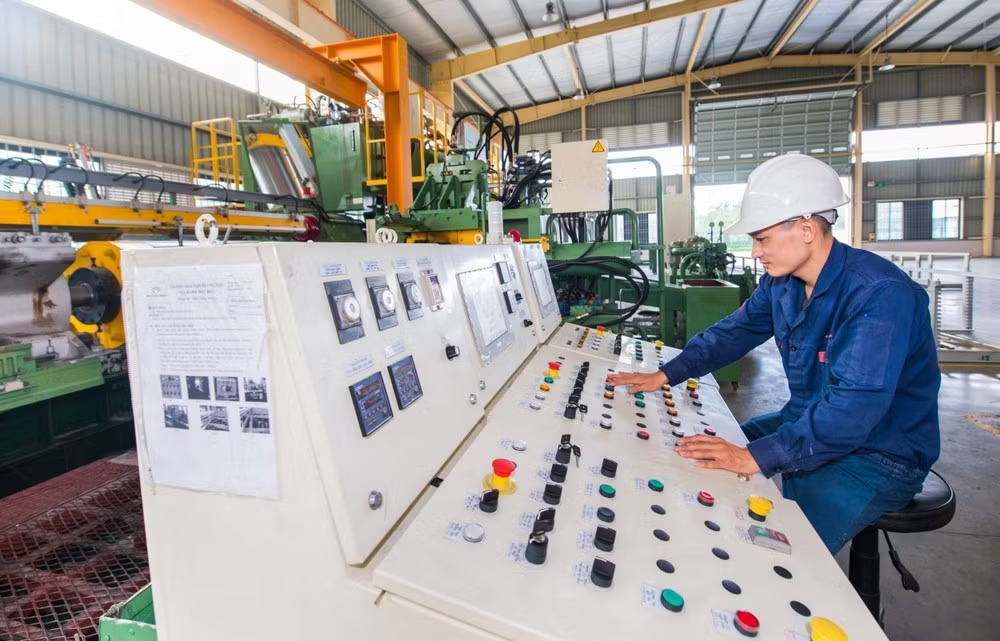
Financial leasing offers an optimal solution for businesses to upgrade machinery without requiring collateral. (Photo: VietnamPlus)

Pham Van Quan, a representative of the Industry Agency under the Ministry of Industry and Trade, said the sector has identified three strategic pillars: institutional reform to cut administrative procedures, policies to raise localisation rates, and digital and green transformation targeting digital profiles for 50,000–100,000 industrial firms by 2030.

Quan also emphasised that Vietnam is shifting its approach to attracting foreign direct investment (FDI) toward a more “conditional” model tied to technology transfer and requirements for establishing research and development (R&D) centres in the country. This is expected to help domestic suppliers access high-tech industries such as semiconductors, clean energy and electric vehicles. Notably, the upcoming Government Decree No. 205/2025/ND-CP is anticipated to provide a major boost by expanding support to raw materials and processing industries, while covering up to 50% of testing and quality certification costs for core technology projects.

Nguyen Duc Hien, Deputy Head of the Party Central Committee’s Commission for Policies and Strategies, noted that suppliers are no longer merely input providers but have become key contributors to national competitiveness in the new development context. The Party and State are finalising strategic resolutions to promote private sector growth and breakthroughs in science and technology, aiming for double-digit economic growth aligned with a new growth model.

A notable policy shift moving forward is that the State will focus on establishing legal frameworks while delegating programme implementation to businesses, associations and universities. The Ministry of Industry and Trade is also accelerating the development of the “Go Global” programme, envisioned as a launchpad to help Vietnamese enterprises expand internationally.

Deeper participation in global value chains led by firms such as Apple and Samsung is expected to strengthen Vietnamese enterprises while enhancing production resilience and economic security./.
VNA

See more

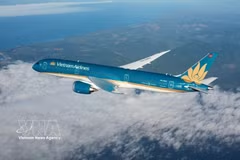
A passenger poses for a photo besides a Vietjet aircraft (Photo: VNA)

Vietjet leads Southeast Asia in emissions efficiency

Under comparable operating conditions, Vietjet’s leading position highlights its ability to optimise performance across its entire operational chain, including aircraft configuration, route network design and load management.

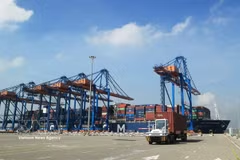
Containers loaded at Cai Mep International Terminal (Photo: VNA)

Vietnam ranks 18th among world’s top exporters in 2025

Vietnam’s exports reached about 470 billion USD for the first time last year, up more than 16% year on year, with a trade surplus of over 20 billion USD, contributing significantly to maintaining macroeconomic stability.

Experts speak at the workshop (Photo: VNA)

Vietnam’s pet care market emerges as lucrative investment opportunity

​ Across the Asia-Pacific, 60% of respondents own pets, while Vietnam’s pet ownership rate stands at 79%, among the highest in the region. Notably, 55% of Vietnamese pet owners have two or more pets, signalling that pet ownership has evolved from a hobby into a modern lifestyle choice.

A view of the workshop on the application of AI and real-world data in food product research and development held in Ho Chi Minh City on April 22. (Photo: VNA)

AI emerges as key driver for Vietnam’s F&B sector breakthrough

Businesses start with projects that deliver quick results within six to 12 months, like quality control systems, demand forecasting, or customer service chatbots. In the long run, F&B companies are advised to move toward with AI-driven operating models to keep up with fast-changing market demands.

Trucks carrying imports enter Vietnam through Lao Cai International Border Gate. (Photo: VNA)

Smart border gates power growth in northern border provinces

With a borderline of about 182 km, Lao Cai aims to turn its border gate economic zone into a key growth engine by adopting a smart border gate model, viewing this as a breakthrough measure for improving management efficiency, reducing logistics expenses, and enhancing customs clearance capacity.

Ken Chau (right), Chairman of the Vietnam Canada Business Association, presents flowers to the organising committee of the Vietnamese Entrepreneurs Awards in Canada 2026 at the event. (Photo: Award organising board)

Vietnamese awards in Canada spotlight community strength

The gala brought together nearly 200 participants, including community leaders, entrepreneurs and guests from across the country, highlighting both the achievements of Vietnamese businesses and the community’s growing role in the socio-economic fabric of Vancouver and other Canadian cities.

Passenger numbers are expected to peak at the start of each break, particularly from the afternoon of April 24 to April 25, with a return wave on April 27 following the Hung Kings Commemoration Day. (Photo: VNA)

Transport sector ramps up capacity for holiday travel surge

Transport experts said the back-to-back holidays will create travel patterns different from previous years. While some people are expected to combine the two breaks into a longer holiday, others will travel during either period depending on personal plans. Passenger flows are therefore likely to be more evenly distributed, helping ease pressure on transport systems.

A worker at the factory of the TNG Investment and Trading Joint Stock Company in the Song Cong I Industrial Park, Thai Nguyen province. (Photo: VNA)

Imports accelerate, powering exports, public revenues

Previous years show that Vietnam typically runs a trade deficit in the first quarter before shifting to a surplus in the latter half of the year. The current deficit, therefore, is considered both normal and indicative of an economy “recharging” for growth.

Vietnamese Minister of Construction Tran Hong Minh and Korean Minister of Land, Infrastructure and Transport Kim Yun-duk hold talks on April 21 in Hanoi. (Photo: The Courtesy of the Ministry of Construction)

Vietnam, RoK step up cooperation in transport infrastructure

Minh noted that in transport, the RoK is currently Vietnam’s second-largest bilateral donor. Since 1996, the Korean Government has provided significant capital for Vietnam’s transport infrastructure, with nine projects completed to date, totalling over 1 billion USD, and six others underway worth nearly 600 million USD.