Hanoi (VNA) - From electronic identification and residency procedures to online public services, foreign residents in Vietnam are beginning to experience changes brought by the country's digital government drive, although differences in administrative interpretation and inter-agency coordination remain obstacles for users and businesses.
Digital Transformation Through the User Experience
The changes reflect efforts under Politburo Resolution No. 57-NQ/TW to place citizens and businesses at the centre of science, technology, innovation and national digital transformation, while changing how government agencies operate and deliver services.
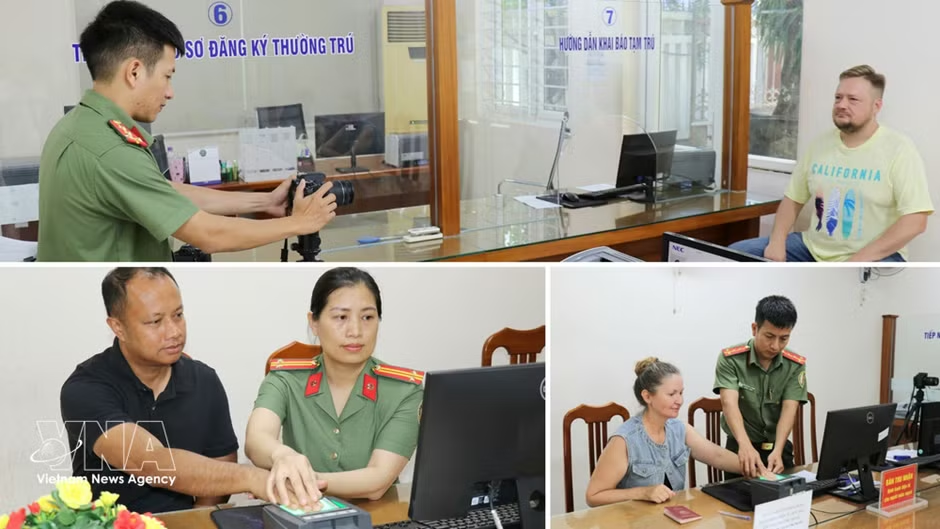
Following the introduction of Government Decree No. 69, foreigners holding valid temporary or permanent residence cards can apply for level-2 electronic identification accounts at immigration authorities, where biometric information is collected.

Kim Ji Eun, Chairwoman of the Board of the KGS International School System, was among the foreigners applying through the Hanoi Police Immigration Division. Her first direct experience of a Vietnamese public administrative procedure on June 25, 2025, she said, was notable for the transparency of the process and users' ability to follow procedures more proactively.
“As a foreign investor, I highly appreciate Vietnam's efforts in administrative reform and digitalisation of public services towards a user-friendly administration, helping individuals and businesses reduce procedures and processing time,” Kim said.
Jeong Young Oh, principal of the KGS International School System, has lived in Vietnam for more than a decade and said technological changes have become increasingly visible in everyday life.
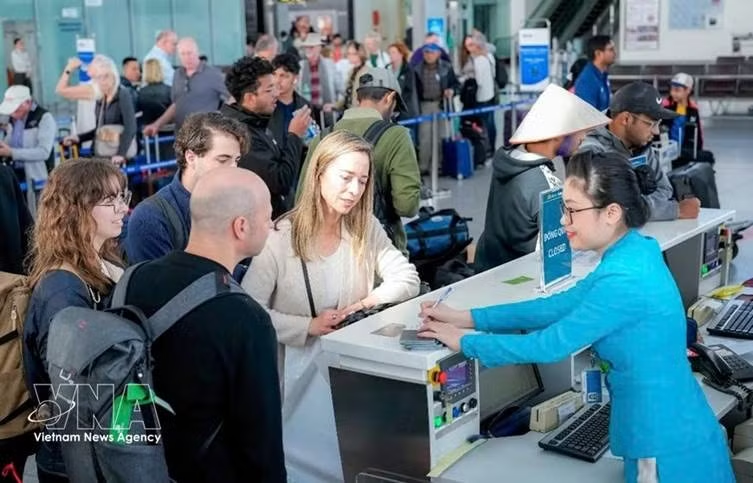
“In recent years, major changes in digitalisation policies have helped accelerate Vietnam's development,” he said, pointing to the ability to use an electronic ticket and VNeID on a mobile phone for air travel instead of presenting paper documents as in previous years.
American English teacher Brinkerhoff Samuel Herbert, who has also taught in countries including the US and Japan, said digital identification was becoming increasingly common globally. While Vietnam remained somewhat behind in certain areas, he said, it was catching up and moving in the right direction.
Dang Tuan Viet, Deputy Director of the Immigration Department, said level-2 e-identification provides foreigners with fully authenticated identities linked to biometric data.
It can help them demonstrate legal residency status in electronic transactions without routinely carrying passports or temporary or permanent residence cards. The accounts can also facilitate some public administrative procedures and transactions involving banking, healthcare and insurance, reducing the need for in-person visits to State agencies.
Since July 1, 2025, immigration authorities have received 87,452 applications and forwarded them to the Police Department for Administrative Management of Social Order, which has issued 84,831 level-2 accounts.
South Korean citizens accounted for the largest number, with 24,582 accounts, followed by Chinese citizens with 18,906 and Japanese citizens with 7,529.
Implementation, however, continues to encounter practical difficulties.
Viet said language remains one obstacle because not all eligible foreigners speak English.
Immigration authorities have therefore had to deploy personnel proficient in other languages, including Korean and Chinese, to provide guidance. Many eligible temporary residence card holders also work in industrial parks, making it difficult for them to arrange time to complete procedures.

For foreign businesses, another concern is consistency between government agencies.
Kim pointed to international education, where she said inter-agency coordination remained a significant bottleneck. When recruiting a foreign expert as a principal, the authority responsible for issuing a work permit may require recognition from the education authority, while the education authority may in turn rely on a work permit issued by the labour authority.
“I believe that once these issues are resolved, Vietnam will quickly complete its comprehensive digital transformation,” she said.
Technology companies developing solutions for the public sector similarly argue that digitalisation needs to extend beyond technology itself.
Innovation for All – A Foundation for Digital Government
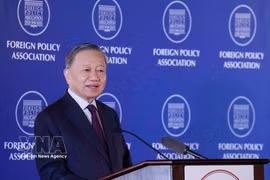
Innovation has been identified as a key driver of digital transformation and public governance reform. This spirit was highlighted at the National Innovation Day held at the National Innovation Center in Hoa Lac. Addressing the event, Party General Secretary To Lam stressed the need to regard science and technology, innovation and digital transformation as key breakthroughs and major drivers of a new development model, with Vietnam aiming to become an upper-middle-income developing country by 2030 and a high-income developed country by 2045.

The drive to link innovation with better governance is also taking shape at the local level. In February 2026, Hanoi hosted an innovation event at the city’s Innovation Center, bringing together technology companies, research institutes, universities and government agencies to discuss solutions for integrating innovation into governance and the development of a modern city.
Innovation for All – A Foundation for Digital Government
Han Minh Cuong, Chairman of SGroup Vietnam and Director of the AIST Institute of Construction Science and Technology, said technical capabilities were only the starting point.
“What matters more is a user-centred governance mindset, so that technology can simplify procedures, shorten processing times and support the daily work of officials as well as citizens,” he said.
His company's CGIS Urban solution, developed by CTECh, received a Sao Khue Award in 2025 in the government digital transformation category after competing among more than 500 nominations. The platform integrates spatial data and smart governance functions to support urban planning, monitoring, administration and decision-making.
The broader innovation agenda has also been linked with public-sector reform. At the National Innovation Day, Party General Secretary To Lam called for science and technology, innovation and digital transformation to serve as major breakthroughs and key drivers in renewing Việt Nam's development model towards its 2030 and 2045 development goals.
For foreign investors such as Kim, the effectiveness of that transformation will also depend on whether technology is accompanied by greater administrative consistency.
“Administrative reform can only truly succeed when policy, people and technology move in step,” she said. “Foreign investors are not looking for privileges, but for clarity, consistency and predictability.”./.