Hanoi (VNA) – Vietnam’s carbon market is shifting from institutional development towards practical implementation, with supply-demand connectivity emerging as a key factor in turning emissions reduction potential into tradable commodities.
Connecting carbon-credit projects, measurement and verification systems with business demand for purchasing and offsetting emissions will be crucial to translating policies into practice and creating economic incentives for the green transition.
First steps towards market transactions
The Ministry of Agriculture and Environment, in coordination with the Institute for Development Consultancy under the International Finance Corporation (IFC), with support from the Swiss State Secretariat for Economic Affairs, on August 14 held the Vietnam Carbon Forum 2026, themed “From Policy to Action.” It drew the participation of 400 delegates from government agencies, financial institutions, businesses and international organisations.
A highlight of the forum was a business networking session aimed at connecting carbon credit suppliers with enterprises seeking to purchase, trade and offset emissions.
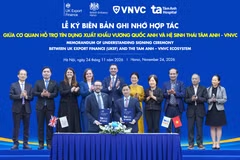
Two memoranda of understanding (MoUs) were signed on connecting the supply and demand for emissions allowances and carbon credits, marking a move towards concrete market commitments.
Nguyen Tuan Quang, Deputy Director of the Department of Climate Change, said hundreds of projects under the Clean Development Mechanism (CDM) had received carbon credits, while some were transitioning to mechanisms under the Paris Agreement. Vietnam also has more than 10 projects under the Joint Crediting Mechanism (JCM), alongside projects applying other carbon standards.
Around 30 organisations currently meet regulatory requirements for carbon-credit certification and validation, reflecting growing demand for verification services, he added.
Pham Lien Anh, IFC Programme Manager for Economic Reform and Research in Vietnam, Laos and Cambodia, said business interest in the carbon market was increasing, with many enterprises developing or preparing carbon projects. The Department of Climate Change and IFC are preparing a guidance handbook to support businesses, she added.
However, Anh said that market expansion requires completing domestic carbon standards, streamlining certification procedures and improving businesses’ understanding of participation. Demand is expected to rise as the market moves beyond its pilot phase and more enterprises become subject to emissions allowance trading requirements.
Expanding markets, rising carbon prices
Experts said the market’s potential also extends beyond domestic demand as it becomes increasingly linked to international trade requirements.
Providing an update on the European Union’s Carbon Border Adjustment Mechanism (CBAM), IFC representative Neeraj Joshi said importers entering the European Union market must disclose emissions embedded in imported goods, with compliance costs currently standing at around 75 EUR per tonne of CO₂ equivalent.
An EU draft proposal would allow 10% of Carbon Border Adjustment Mechanism (CBAM) obligations to be offset through carbon credits. If adopted, the measure could generate additional international demand and create opportunities for countries such as Vietnam.
Domestically, authorities are considering recognising credits developed under independent standards, including Verra and Gold Standard, for domestic trading.
Nguyen Tuan Anh, Deputy Director General of the Hanoi Stock Exchange, said the domestic carbon market currently has no price fluctuation band. Eligible credits registered on the National Registration System and transferred to the depository system can be traded at freely negotiated prices, depending on their quality, origin and characteristics.
Dr. Le Xuan Nghia, Director of the Institute for Development Consultancy and a member of the National Financial and Monetary Policy Advisory Council, cited World Bank forecasts that a carbon price of around 147 USD per tonne could significantly influence emitters’ decisions.
Higher carbon costs would encourage businesses to invest in cleaner technologies and adopt less emissions-intensive production processes, he said.
Anh highlighted an untapped source of carbon-credit potential, noting that a 2025 IFC and Department of Climate Change survey found many businesses had already implemented energy-saving and emissions-reduction measures but were unaware that these could be developed into carbon-credit projects.
To participate in the market, businesses first need to quantify their emissions, identify major sources and establish capacity for measurement, monitoring, reporting and verification (MRV). However, Vietnamese businesses still have limited MRV capacity, while digitalisation of relevant data remains at an early stage.
Anh recommended that businesses identify emissions-reduction solutions with carbon-credit potential and determine their target market, whether voluntary or compliance-based, domestic or international under Article 6.2 of the Paris Agreement./.